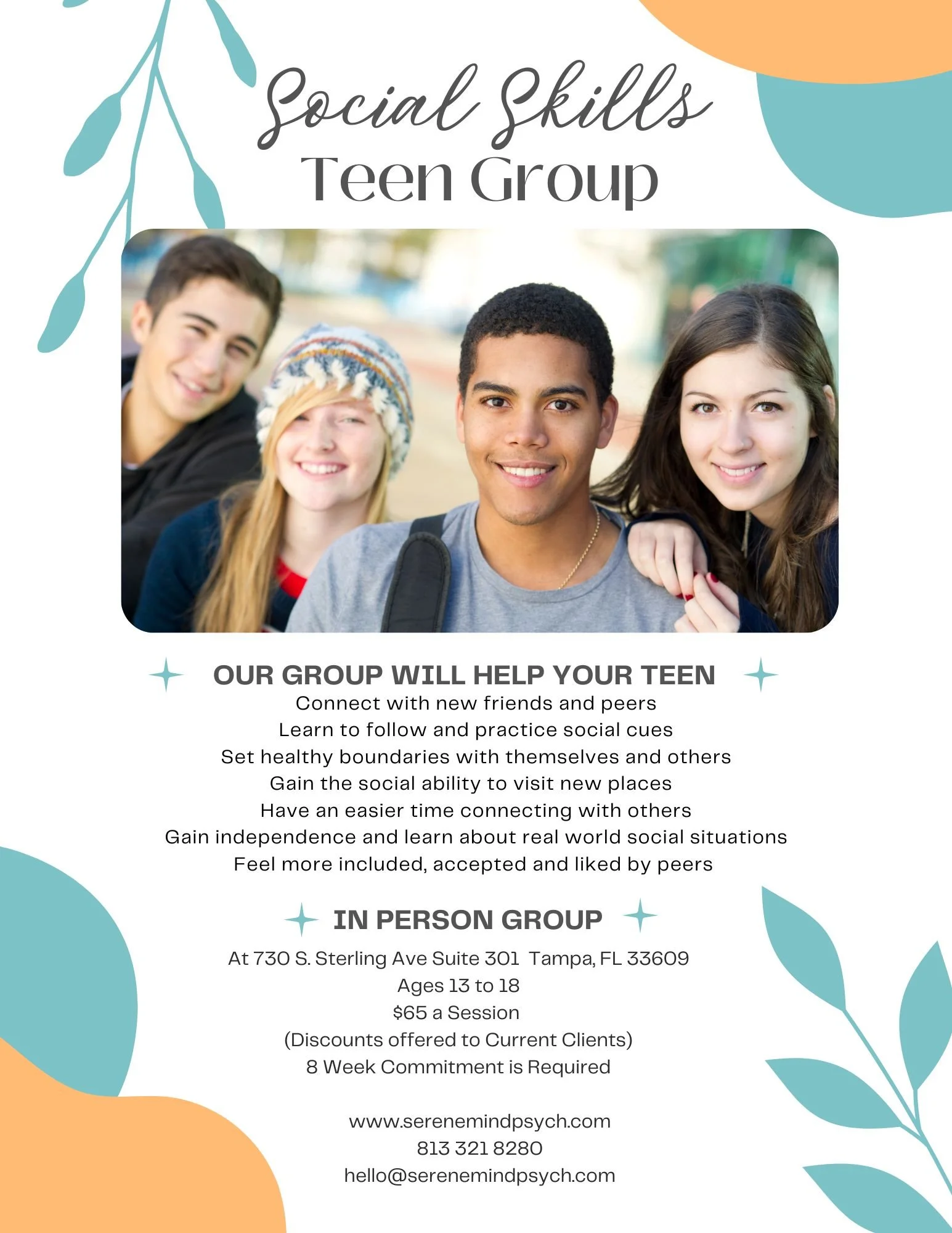
More Than Social Skills: Helping Teens Build Confidence, Connection, and Belonging
/Being a teenager can feel complicated—even when everything looks fine from the outside.
Friendships change. Social expectations become more complicated. Teens are navigating independence, identity, school pressures, emotions, and the constant question of “Where do I fit in?”
For some teens, connecting with others comes naturally. For others, social situations can feel confusing, exhausting, overwhelming, or even anxiety-provoking. They may want friends but struggle to know how to enter a conversation, keep one going, understand social cues, handle conflict, or recover when something goes wrong.
And sometimes, a teen may simply need a little more practice in a supportive environment.
Social skills aren't about changing who your teen is
A social skills group should never be about teaching a teen to “act normal” or become someone they are not.
Instead, the goal is to help teens develop practical tools that allow them to communicate more comfortably, understand themselves and others, navigate relationships, and build meaningful connections while still being themselves.
Research supports the value of structured social skills interventions for adolescents. A systematic review of 16 studies found that group social skills interventions improved social skills, social knowledge, and social responsiveness among adolescents with developmental disabilities, with the strongest evidence currently available for teens with autism.
But social skills are only one piece of the puzzle.
Connection starts with feeling safe
It is difficult to learn a new social skill when your nervous system is already in a state of stress.
A teen who becomes overwhelmed in groups may have difficulty thinking flexibly, finding the right words, reading another person's expression, or knowing what to do next. That doesn't necessarily mean they don't know the skill. Sometimes their brain and body are simply having difficulty accessing it in the moment.
This is where a nervous-system-informed approach can be helpful.
In our teen social skills group, we incorporate opportunities to notice body signals, practice regulation, slow down reactions, and build awareness of what happens internally during social interactions. Teens can learn to recognize, “I'm getting overwhelmed,” before they reach the point of shutting down, withdrawing, becoming reactive, or wanting to leave.
The teenage brain is still learning
Adolescence is a particularly important developmental period for social learning. The adolescent brain continues undergoing significant changes involving neural connections, myelination, and reorganization. Research also shows that adolescents are particularly responsive to social information and learning from their social environments.
That means social experiences can become opportunities for learning.
With repetition, feedback, reflection, and supportive practice, teens can strengthen new patterns of responding. This is one reason we incorporate neuro-retraining principles into social-emotional work: rather than simply telling a teen what they should do, we create opportunities to practice noticing, regulating, choosing, communicating, and trying again.
The goal isn't perfection.
It's creating more options.
Instead of:
“I don't know what to say.”
A teen can learn:
“I can ask a question.”
Instead of:
“Everyone thinks I'm weird.”
They can learn:
“Maybe I don't know what they're thinking. I can check the situation before assuming.”
Instead of:
“I messed up, so I'm done.”
They can learn:
“That interaction didn't go how I wanted. I can try again.”
What teens can practice in a social skills group
Our group provides a supportive environment where teens can practice skills such as:
Starting and maintaining conversations
Reading social cues and body language
Understanding perspective and different points of view
Joining a group or entering a conversation
Handling disagreements and misunderstandings
Setting boundaries and respecting others' boundaries
Managing social anxiety and overwhelm
Developing confidence and self-advocacy
Recognizing thoughts, emotions, and body signals
Building and maintaining friendships
Recovering from awkward or uncomfortable social moments
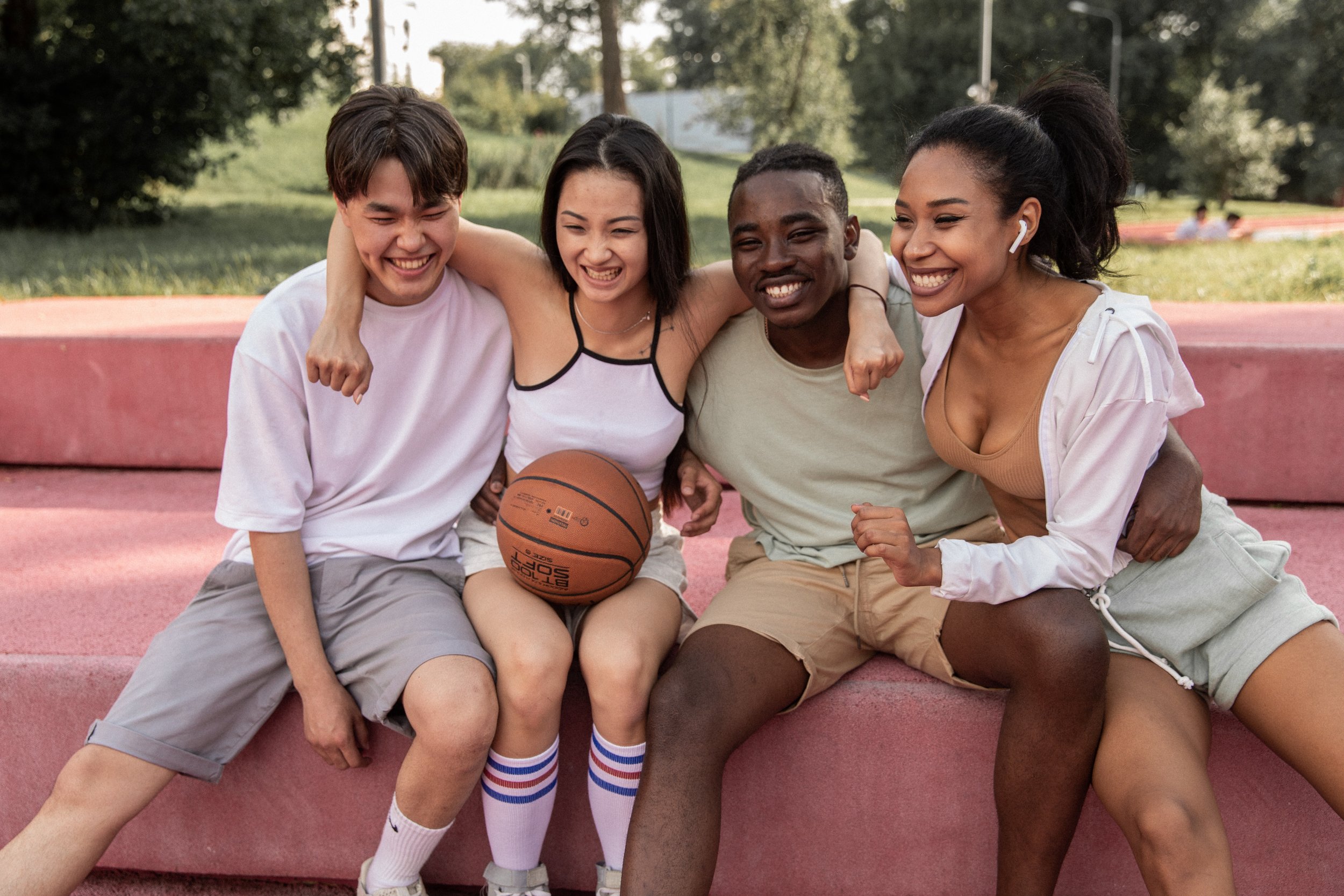
Most importantly, teens get the opportunity to practice these skills with other teens.
That matters.
Research on adolescent connectedness has found that supportive relationships and a sense of belonging are important protective factors for youth. Studies of interventions designed to increase social connectedness have also found improvements in social connectedness, with some additional positive effects on self-esteem and depressive symptoms.
Your teen doesn't have to figure it out alone
Sometimes the teen who appears quiet doesn't know how to join in.
Sometimes the teen who talks constantly is trying desperately to connect.
Sometimes the teen who says, “I don't care,” cares very deeply.
And sometimes a teen simply hasn't found their people yet.
A social skills group can provide more than skills. It can provide a place to practice, make mistakes without judgment, learn from peers, discover strengths, and experience what it feels like to be understood.
At Serene Mind Counseling + Evaluations, we believe that social growth isn't about forcing connection. It's about helping teens develop the confidence, awareness, flexibility, and regulation skills that make connection feel more possible.
Your teen doesn't need to become someone else to belong.
They may simply need the right environment, the right tools, and opportunities to practice.
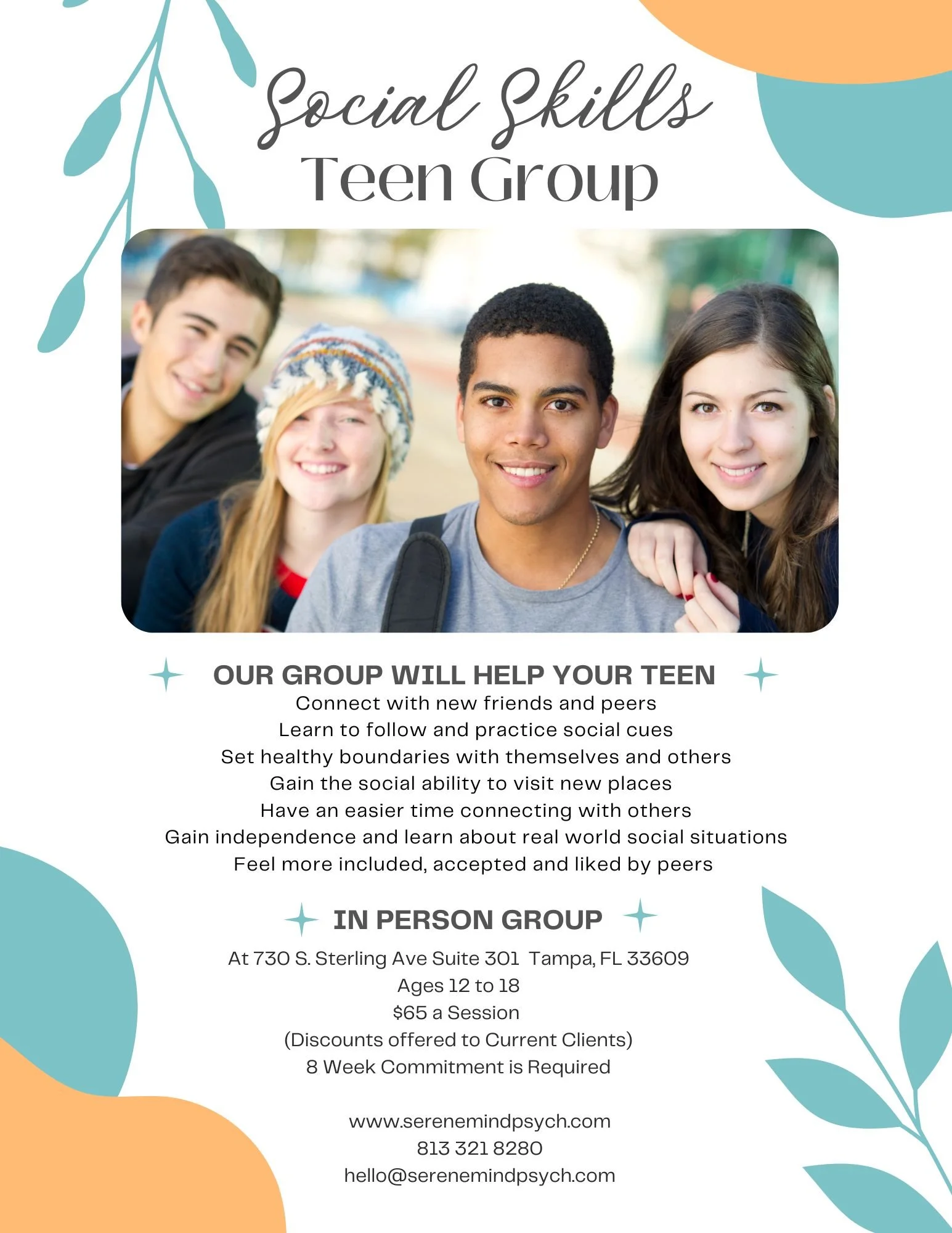
Ready to help your teen feel more confident and connected?
Our Teen Social Skills Group is designed to give adolescents a supportive space to practice real-life social and emotional skills while building confidence and connection with peers.
Serene Mind Counseling + Evaluations
Tampa, Florida
813-321-8280
hello@serenemindpsych.com
Learn more about our Teen Social Skills Group and reach out to see whether it may be a good fit for your teen.