When You’re Doing Everything but Still Feel Overwhelmed: Understanding Your Nervous System

You’re getting things done.

You’re answering the texts. Getting the kids where they need to go. Showing up for work. Making the appointments. Taking care of everyone else. Somehow, you’re keeping everything moving.

But inside, you’re exhausted.

You may feel like you’re constantly “on.” Your mind keeps running even when you finally sit down. Small things bother you more than they used to. You’re more irritable, anxious, emotional, or easily overwhelmed. Maybe you have trouble relaxing because there is always something else to think about.

And when someone asks, “What’s wrong?” you may not even know what to say.

You’re functioning. But you don’t feel okay.

This is something many parents and adults experience, particularly during seasons of high stress, major life changes, postpartum, caregiving, or simply after spending a long time putting everyone else first.

Sometimes the problem isn't that you need to become better at managing your life.

Sometimes your nervous system is tired.

What does your nervous system have to do with it?

Your nervous system is constantly taking in information and deciding whether you are safe, threatened, overwhelmed, or able to relax.

When you've been under stress for a long time, your body can become accustomed to being on alert.

You might notice:

  • Racing thoughts

  • Trouble sleeping

  • Feeling restless or “wired”

  • Irritability or a shorter fuse

  • Feeling overwhelmed by normal tasks

  • Difficulty slowing down

  • Feeling disconnected or numb

  • Constantly anticipating what could go wrong

  • Feeling exhausted but unable to relax

This doesn't mean something is wrong with you.

It may mean your body has gotten very good at protecting you.

The goal isn't to force yourself to “calm down” or tell yourself that everything is fine.

The goal is to help your brain and body learn that they don't have to stay in survival mode all the time.

Sometimes you need more than coping skills

Breathing exercises and mindfulness can be helpful, but sometimes there is more underneath the overwhelm.

Past experiences, trauma, chronic stress, difficult relationships, major transitions, parenting stress, postpartum changes, or years of putting your own needs last can all contribute to patterns that are difficult to change on your own.

This is where a nervous-system-informed approach to therapy can be helpful.

Therapy may incorporate somatic-informed techniques, grounding and regulation skills, trauma-informed approaches, and Accelerated Resolution Therapy (ART) when appropriate.

ART, for example, can help people process difficult experiences and emotional responses without requiring them to repeatedly talk through every detail of what happened.

The goal isn't to erase your experiences.

It's to help you feel less controlled by them.

And importantly, therapy doesn't have to be reserved for a crisis.

You can seek support because you're tired.

Because you're overwhelmed.

Because you don't recognize yourself lately.

Because you want to respond differently to your children.

Because you're ready to stop living in constant “go mode.”

Signs you may benefit from this kind of support

You might consider nervous-system-informed therapy if:

1. You can't seem to turn your brain off.
Even when nothing is happening, you're thinking, planning, worrying, or preparing for the next thing.

2. Small things feel BIG.
You find yourself becoming frustrated, angry, tearful, or overwhelmed by things that normally wouldn't affect you as much.

3. You're always taking care of everyone else.
You know how to show up for other people, but you're not sure how to make space for yourself.

4. You feel disconnected from yourself.
You may feel like you're going through the motions rather than actually enjoying your life.

5. Your body feels like it's constantly “on.”
You may notice tension, restlessness, difficulty sleeping, or a constant sense that something needs your attention.

6. You understand your patterns but can't seem to change them.
You know where some of your reactions come from, but knowing isn't always enough to make your body respond differently.

Four things you can try on your own

1. Slow down before you solve.

When something stressful happens, give yourself 30 seconds before immediately jumping into problem-solving.

Take a slow breath. Feel your feet on the floor. Look around the room.

Tell yourself:

“I can respond to this. I don't have to solve everything right now.”

2. Notice what your body is telling you.

Instead of asking only, “What's wrong with me?” try asking:

“What is my body experiencing right now?”

Are your shoulders tight? Is your jaw clenched? Is your heart racing? Are you holding your breath?

Simply noticing can be the beginning of changing the pattern.

3. Create tiny moments of safety.

You don't need an hour of meditation.

Try sitting outside for five minutes, listening to calming music, taking a warm shower, stretching, drinking something slowly, or stepping away from your phone.

Think small and consistent, not perfect.

4. Practice repair instead of perfection.

You will lose your patience.

You will have hard days.

You may yell at your child, cancel plans, or realize you have been running on empty.

Instead of deciding you've failed, practice repair.

“I was overwhelmed. I'm sorry. I'm going to try that differently next time.”

Repair teaches your nervous system—and the people around you—that a difficult moment doesn't have to become a permanent pattern.

You don't have to do this perfectly

Learning to regulate your nervous system isn't about becoming calm all the time.

It's about noticing when you're overwhelmed, understanding what your body is communicating, and having more choices in how you respond.

Sometimes you can do that with simple tools at home.

Sometimes you need someone to walk alongside you.

And sometimes having a compassionate therapist who understands both the emotional and physical experience can make the process feel much less overwhelming.

If you're in Jacksonville, Nikki Tucker, LMHC offers a warm, nervous-system-informed approach that may incorporate somatic techniques, regulation strategies, trauma-informed therapy, and ART when appropriate. She works with adults, parents, teens, and children and offers daytime appointments in Jacksonville as well as virtual therapy throughout Florida.

You don't have to wait until you're falling apart to ask for support.

Sometimes you just need a place to exhale. 🤍

When You’re Doing Everything but Still Feel Overwhelmed: Understanding Your Nervous System

When Everyone Flips Their Lid: Nervous System Regulation for Burned-Out Parents and Big Feelings

If you have ever had a toddler melt down in the grocery store, a teenager slam a door, or a partner become completely overwhelmed during an argument, you probably know the feeling of thinking, “How do I get them to calm down?”

But there is another question that can be just as important:

“What is happening in their nervous system right now—and what is happening in mine?”

We often talk about emotional regulation as if it is simply a matter of choosing to calm down. But when someone is overwhelmed, angry, panicked, crying, shutting down, or completely losing their ability to communicate, their nervous system may be responding to stress before their thinking brain has a chance to catch up.

This is especially important for burned-out parents and caregivers. When you are already exhausted, overstimulated, touched out, worried about work, managing schedules, answering endless questions, and trying to meet everyone's needs, your own nervous system may already be operating close to its limit.

Then your child has a meltdown.

And suddenly, everyone is dysregulated.

What Does “Flipping Your Lid” Actually Mean?

The phrase “flipping your lid” is often used to describe what happens when our emotional response becomes so intense that it becomes difficult to think clearly, communicate, problem-solve, or respond calmly.

This can happen to children, teenagers, and adults.

A toddler may scream, throw themselves on the floor, hit, cry, or refuse to cooperate. A teenager may yell, isolate, slam a door, or say things they don't really mean. An adult may become defensive, raise their voice, shut down, or feel like they need to escape the conversation.

These behaviors can look very different, but underneath them may be a nervous system that is overwhelmed.

And here's something important for parents:

A dysregulated child does not need a lecture about regulation. They need help experiencing regulation.

Young children especially learn regulation through repeated experiences with safe, responsive adults. This doesn't mean allowing unsafe behavior or giving in to every demand. It means recognizing that connection and regulation often need to come before correction.

The Parent's Nervous System Matters Too

One of the hardest parts of parenting is that children don't always become calmer simply because we tell them to calm down.

In fact, when a parent is yelling, rushing, threatening, or visibly overwhelmed, the child's nervous system may interpret that as additional stress.

This doesn't mean you have to be perfectly calm all the time.

You are human.

Parents get frustrated. Parents lose patience. Parents have bad days. Parents sometimes need to step away and take a breath before responding.

The goal isn't perfect regulation.

The goal is repair, awareness, and practicing a different response over time.

Sometimes the most powerful thing a parent can do during a child's meltdown is regulate themselves first.

Take a breath.

Lower your voice.

Slow your movements.

Unclench your jaw.

Drop your shoulders.

Remind yourself:

“My child is having a hard time. I don't have to have a hard time in exactly the same way.”

What Can You Do When Someone Is Dysregulated?

When someone's nervous system is highly activated, trying to reason with them may not be very effective in that moment.

Instead, think about safety, connection, and reducing stimulation.

1. Slow Yourself Down

Before responding, pause for a moment.

Take one slower breath than usual. Put both feet on the floor. Relax your shoulders. Notice whether you are speaking quickly or raising your voice.

You don't have to become completely calm.

You just need to become a little more regulated than the moment before.

That small shift can change the tone of the interaction.

2. Use Fewer Words

When someone is overwhelmed, long explanations can feel like more stimulation.

Instead of:

"We've already talked about this five times and I told you that you can't do that, and now you're making this situation worse..."

Try:

"You're really upset. I'm here. We're going to figure this out."

Short. Calm. Clear.

There will be plenty of time for teaching and problem-solving later.

3. Don't Confuse Regulation With Permissiveness

Helping someone regulate does not mean allowing unsafe or disrespectful behavior.

You can be compassionate and hold a boundary at the same time.

For example:

"I know you're angry. It's okay to be angry. I won't let you hit me. I'm going to give you some space, and we'll talk when we're both calmer."

The message becomes:

Your feelings are allowed. Unsafe behavior is not. I am still here.

That is a powerful combination.

4. Reduce Stimulation

Sometimes the simplest intervention is changing the environment.

Turn off the television. Move away from a crowded room. Lower your voice. Dim the lights. Give the person physical space. Stop asking multiple questions.

For some people, regulation begins when there is simply less coming at them.

5. Try Connection Before Correction

When a child is completely overwhelmed, correcting the behavior immediately may not accomplish much.

First, help them feel safe enough to come back into a more regulated state.

You might say:

"That was really disappointing."

"You really wanted that toy."

"You're having a big feeling right now."

This doesn't mean agreeing with inappropriate behavior. It means showing the child that their emotional experience is being noticed.

Once the nervous system settles, you can teach.

Regulate. Relate. Then reason.

What About When It's You Who Is Flipping Your Lid?

This is where nervous system regulation becomes especially important for burned-out moms, caregivers, partners, and anyone who feels like they are constantly carrying too much.

Sometimes the problem isn't that you don't know enough coping skills.

Sometimes you're simply overloaded.

You may need rest.

You may need fewer demands.

You may need help.

You may need boundaries.

You may need ten minutes alone without someone asking you a question.

You may need to stop expecting yourself to function at 100% when your body and mind are telling you that you're running on empty.

Regulation isn't just about what you do during a crisis.

It is also about what you do before the crisis happens.

Regular movement, adequate sleep when possible, nourishing meals, time outside, supportive relationships, enjoyable activities, breathing exercises, mindfulness, and moments of quiet can all become part of creating a nervous system that has more capacity to handle stress.

And sometimes, professional support can help you understand why your nervous system reacts so strongly in certain situations and how to develop healthier patterns.

You Don't Have to Be the Calm Parent All the Time

There is so much pressure on parents to get everything right.

The perfect response.

The perfect bedtime routine.

The perfect emotional regulation strategy.

The perfect consequence.

But children don't need perfect parents.

They need safe enough, responsive, loving humans who are willing to keep learning.

If you lose your patience, you can repair.

"I was really frustrated, and I raised my voice. I'm sorry. You didn't deserve to be yelled at. I'm going to work on slowing down when I'm overwhelmed."

That moment matters.

Repair teaches children something incredibly important:

Relationships can survive hard moments.

We can make mistakes and reconnect.

We can have big feelings without being defined by them.

We can learn how to pause.

We can try again.

And perhaps most importantly, we can stop thinking about nervous system regulation as another thing we have to be perfect at.

Instead, we can see it as a practice.

A breath.

A pause.

A softer voice.

A little more space.

A boundary held with compassion.

A moment of connection.

A repair after a difficult interaction.

These small moments add up.

And when we learn to notice our own nervous system while helping our children, partners, and loved ones navigate theirs, we create more opportunities for everyone to feel safe, connected, and understood.

You don't have to calm the entire world around you. Start with one nervous system at a time—including your own.

When Everyone Flips Their Lid: Nervous System Regulation for Burned-Out Parents and Big Feelings

More Than Social Skills: Helping Teens Build Confidence, Connection, and Belonging

Being a teenager can feel complicated—even when everything looks fine from the outside.

Friendships change. Social expectations become more complicated. Teens are navigating independence, identity, school pressures, emotions, and the constant question of “Where do I fit in?”

For some teens, connecting with others comes naturally. For others, social situations can feel confusing, exhausting, overwhelming, or even anxiety-provoking. They may want friends but struggle to know how to enter a conversation, keep one going, understand social cues, handle conflict, or recover when something goes wrong.

And sometimes, a teen may simply need a little more practice in a supportive environment.

Social skills aren't about changing who your teen is

A social skills group should never be about teaching a teen to “act normal” or become someone they are not.

Instead, the goal is to help teens develop practical tools that allow them to communicate more comfortably, understand themselves and others, navigate relationships, and build meaningful connections while still being themselves.

Research supports the value of structured social skills interventions for adolescents. A systematic review of 16 studies found that group social skills interventions improved social skills, social knowledge, and social responsiveness among adolescents with developmental disabilities, with the strongest evidence currently available for teens with autism.

But social skills are only one piece of the puzzle.

Connection starts with feeling safe

It is difficult to learn a new social skill when your nervous system is already in a state of stress.

A teen who becomes overwhelmed in groups may have difficulty thinking flexibly, finding the right words, reading another person's expression, or knowing what to do next. That doesn't necessarily mean they don't know the skill. Sometimes their brain and body are simply having difficulty accessing it in the moment.

This is where a nervous-system-informed approach can be helpful.

In our teen social skills group, we incorporate opportunities to notice body signals, practice regulation, slow down reactions, and build awareness of what happens internally during social interactions. Teens can learn to recognize, “I'm getting overwhelmed,” before they reach the point of shutting down, withdrawing, becoming reactive, or wanting to leave.

The teenage brain is still learning

Adolescence is a particularly important developmental period for social learning. The adolescent brain continues undergoing significant changes involving neural connections, myelination, and reorganization. Research also shows that adolescents are particularly responsive to social information and learning from their social environments.

That means social experiences can become opportunities for learning.

With repetition, feedback, reflection, and supportive practice, teens can strengthen new patterns of responding. This is one reason we incorporate neuro-retraining principles into social-emotional work: rather than simply telling a teen what they should do, we create opportunities to practice noticing, regulating, choosing, communicating, and trying again.

The goal isn't perfection.

It's creating more options.

Instead of:

“I don't know what to say.”

A teen can learn:

“I can ask a question.”

Instead of:

“Everyone thinks I'm weird.”

They can learn:

“Maybe I don't know what they're thinking. I can check the situation before assuming.”

Instead of:

“I messed up, so I'm done.”

They can learn:

“That interaction didn't go how I wanted. I can try again.”

What teens can practice in a social skills group

Our group provides a supportive environment where teens can practice skills such as:

  • Starting and maintaining conversations

  • Reading social cues and body language

  • Understanding perspective and different points of view

  • Joining a group or entering a conversation

  • Handling disagreements and misunderstandings

  • Setting boundaries and respecting others' boundaries

  • Managing social anxiety and overwhelm

  • Developing confidence and self-advocacy

  • Recognizing thoughts, emotions, and body signals

  • Building and maintaining friendships

  • Recovering from awkward or uncomfortable social moments

Most importantly, teens get the opportunity to practice these skills with other teens.

That matters.

Research on adolescent connectedness has found that supportive relationships and a sense of belonging are important protective factors for youth. Studies of interventions designed to increase social connectedness have also found improvements in social connectedness, with some additional positive effects on self-esteem and depressive symptoms.

Your teen doesn't have to figure it out alone

Sometimes the teen who appears quiet doesn't know how to join in.

Sometimes the teen who talks constantly is trying desperately to connect.

Sometimes the teen who says, “I don't care,” cares very deeply.

And sometimes a teen simply hasn't found their people yet.

A social skills group can provide more than skills. It can provide a place to practice, make mistakes without judgment, learn from peers, discover strengths, and experience what it feels like to be understood.

At Serene Mind Counseling + Evaluations, we believe that social growth isn't about forcing connection. It's about helping teens develop the confidence, awareness, flexibility, and regulation skills that make connection feel more possible.

Your teen doesn't need to become someone else to belong.

They may simply need the right environment, the right tools, and opportunities to practice.

Ready to help your teen feel more confident and connected?

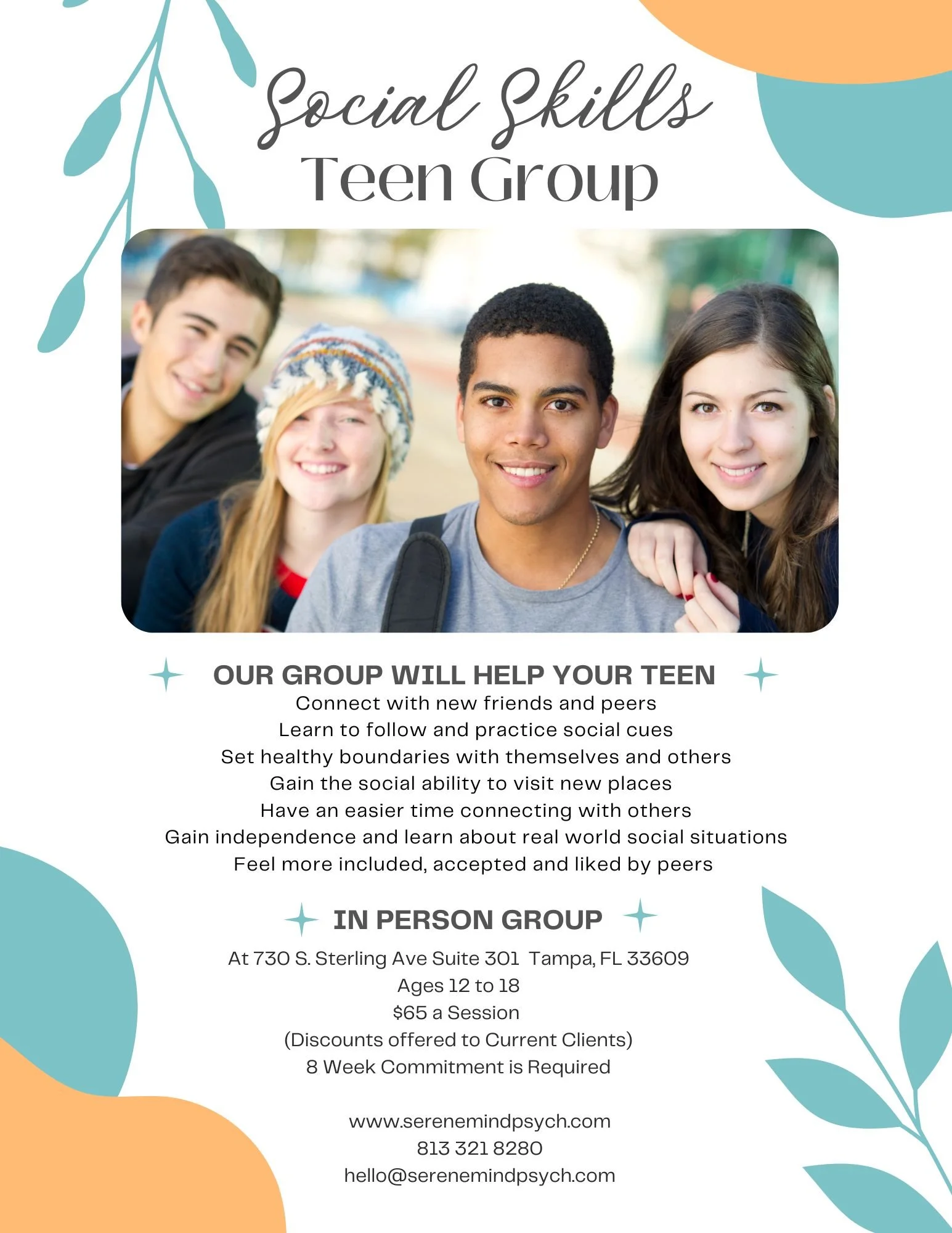
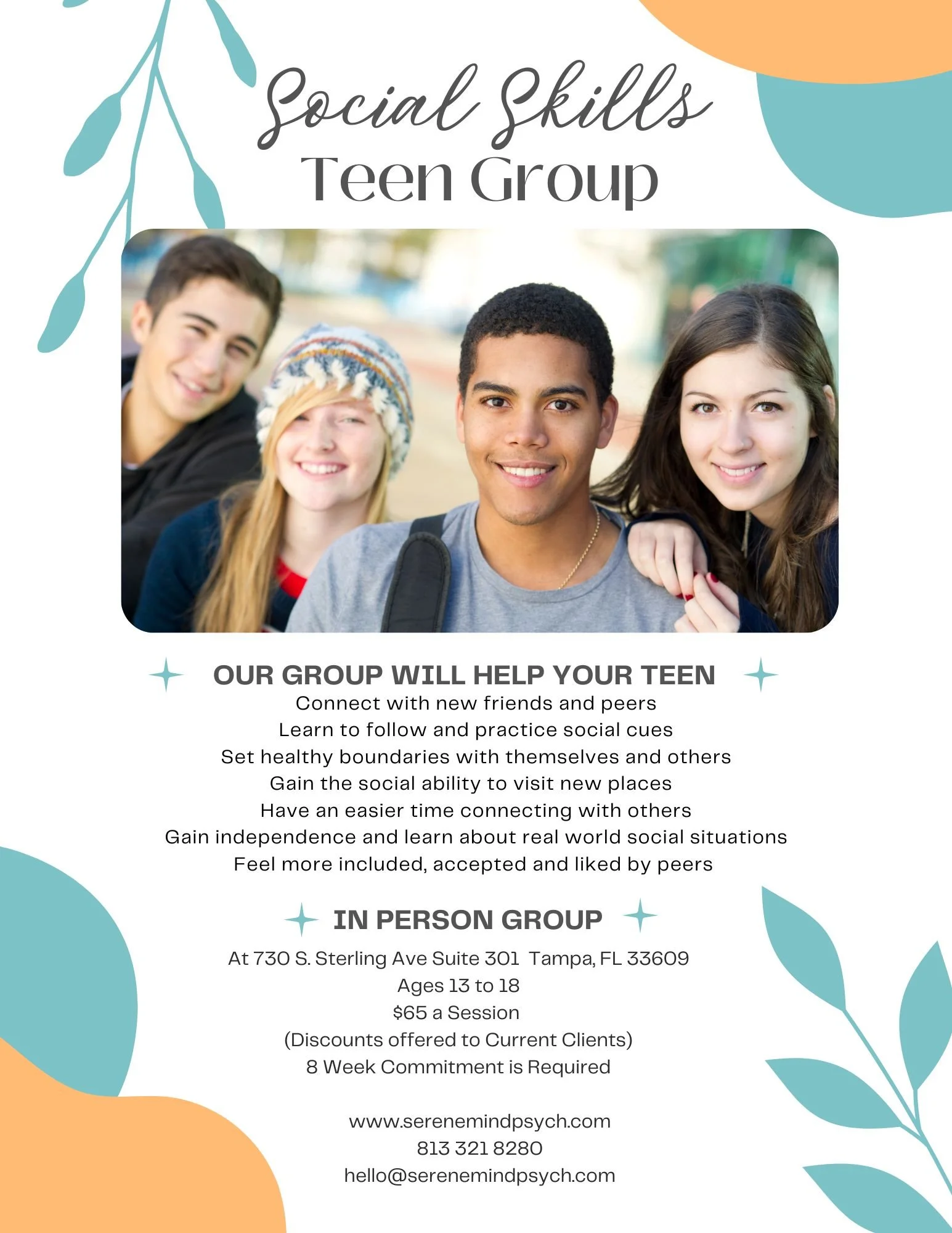
Our Teen Social Skills Group is designed to give adolescents a supportive space to practice real-life social and emotional skills while building confidence and connection with peers.

Serene Mind Counseling + Evaluations
Tampa, Florida
813-321-8280
hello@serenemindpsych.com

Learn more about our Teen Social Skills Group and reach out to see whether it may be a good fit for your teen.

More Than Social Skills: Helping Teens Build Confidence, Connection, and Belonging

Is It Really Attitude...Or an Overloaded Nervous System?

If you've ever found yourself saying, "I don't even recognize my teenager anymore," you're certainly not alone.

One moment they're laughing at dinner, and the next they're slamming a bedroom door. They withdraw from family, spend hours alone, become irritable over seemingly small things, or react intensely to situations that don't seem like a big deal.

It's easy to assume they're simply being dramatic or difficult.

But what if much of this behavior isn't a character problem at all?

What if it's biology?

The teenage brain and nervous system are undergoing one of the most significant periods of development since infancy. During adolescence, the emotional centers of the brain become highly active while the parts responsible for planning, reasoning, and impulse control are still under construction. At the same time, teens are navigating academic demands, friendships, extracurricular activities, social media, changing bodies, and figuring out who they are.

That's a tremendous amount for any nervous system to process.

The Nervous System Is Always Asking One Question

At its core, the nervous system is constantly scanning the environment for one thing:

Am I safe?

This process happens automatically, long before conscious thought.

When the nervous system perceives safety, teens are able to learn, problem solve, connect with others, and regulate emotions more effectively.

When it detects stress, overwhelm, or perceived danger—even if there isn't an actual threat—it shifts into survival mode.

This isn't a choice.

It's an automatic protective response.

Instead of thinking clearly, the body prepares to fight, flee, freeze, or shut down.

Many common teen behaviors begin to make much more sense through this lens.

The teen who lashes out may be stuck in a fight response.

The teen who constantly avoids responsibilities may be operating from a flight response.

The teen who seems emotionally numb or disconnected may actually be in a freeze response.

These behaviors aren't signs of a "bad kid." They're signs of a nervous system working overtime to stay protected.

Stress Looks Different Today

Today's teenagers face challenges that previous generations simply didn't.

Their brains rarely get true downtime.

Notifications, constant comparison through social media, academic competition, world events, sports schedules, and pressure to succeed keep many nervous systems in a near-constant state of activation.

Even positive experiences—new friendships, dating, driving, sports, or preparing for college—can create significant stress because change itself requires adaptation.

For some teens, earlier experiences such as bullying, family conflict, chronic illness, learning differences, anxiety, or trauma further increase nervous system sensitivity.

Over time, the body begins expecting stress even during everyday situations.

Behavior Is Communication

One of the biggest shifts parents and caregivers can make is viewing behavior as communication rather than defiance.

Instead of asking,

"What's wrong with my teen?"

try asking,

"What is their nervous system trying to tell me?"

A teenager who refuses school may not simply be avoiding responsibility.

Their nervous system may genuinely experience school as overwhelming.

The teen who spends hours alone in their room may not be rejecting family.

They may be attempting to recover from a day of constant sensory and emotional input.

The teen who explodes over something small may have been carrying stress long before that moment.

The small event was simply the tipping point.

When adults become curious instead of reactive, conversations often become safer—and healing begins.

Connection Before Correction

When teens are dysregulated, lectures rarely work.

Neither does logic.

This is because the thinking part of the brain temporarily goes offline during stress.

Before teaching, correcting, or solving the problem, the nervous system first needs to feel safe.

That doesn't mean eliminating boundaries.

Healthy limits remain important.

But how we deliver those limits matters.

A calm adult nervous system helps regulate a dysregulated teen nervous system.

Your steady presence often communicates safety more effectively than the perfect words ever could.

Small Moments Matter

Many parents worry they're not doing enough.

Fortunately, nervous system regulation isn't about creating perfect families.

It's about creating repeated moments of safety.

These moments can be surprisingly simple:

Sitting together during a car ride.

Taking the dog for a walk.

Cooking dinner together.

Watching a favorite show.

Laughing.

Playing a game.

Listening without immediately offering solutions.

These seemingly ordinary experiences tell the nervous system:

"I am safe."

"I belong."

"I don't have to handle everything alone."

Over time, these moments build resilience.

Supporting Regulation Isn't About Fixing

As parents, it's natural to want to solve problems quickly.

But nervous system healing is less about fixing and more about creating conditions where regulation becomes possible.

Sometimes that means helping teens identify what they're feeling.

Sometimes it means encouraging movement after a stressful school day.

Sometimes it means protecting downtime instead of overscheduling every hour.

Sometimes it simply means sitting beside them in silence.

Every regulated interaction becomes another opportunity for the brain and body to learn that connection is safe.

The Takeaway

Teen behavior often makes much more sense when we look beneath the surface.

While accountability and healthy expectations are still important, understanding the nervous system reminds us that behavior is often rooted in biology rather than willful disobedience.

The goal isn't raising a teenager who never struggles.

The goal is raising one who learns how to recognize stress, understand their body's signals, and return to regulation with the support of caring adults.

When we stop asking, "How do I stop this behavior?" and begin asking, "What does my teen need to feel safe enough to thrive?" we create space for stronger relationships, healthier communication, and lasting emotional resilience.

Because underneath every overwhelmed nervous system is a young person who isn't giving us a hard time—they're often having a hard time.

Is It Really Attitude...Or an Overloaded Nervous System?

Human by Nature: Understanding the Nervous System and the Wisdom of the Body

Have you ever had a moment where your mind knew you were safe, but your body felt anything but safe?

Maybe your heart raced during a simple conversation. Maybe you felt overwhelmed by something that seemed small. Maybe you found yourself exhausted, disconnected, anxious, or stuck in patterns you couldn’t explain.

These experiences are not signs that something is wrong with you. They are signs that your body is communicating.

At the core of our human experience is a powerful system designed to protect us: the nervous system.

Your Nervous System Is Always Listening

Your nervous system is constantly scanning your environment and your experiences, asking one important question:

“Am I safe?”

Long before we consciously think through a situation, our nervous system is gathering information. It notices facial expressions, tone of voice, body language, memories, sensations, and changes in our environment.

This process helps us respond quickly when we need protection. It allows us to move away from danger, connect with others, focus on important tasks, and adapt to life’s challenges.

The nervous system is not designed to make life difficult—it is designed to help us survive.

However, when we experience ongoing stress, trauma, illness, uncertainty, or overwhelming circumstances, our nervous system can become stuck in patterns of protection.

When Protection Becomes Exhausting

Many people live with a nervous system that has been working overtime.

This may look like:

  • Feeling constantly “on edge”

  • Difficulty relaxing even when things are calm

  • Feeling overwhelmed by everyday demands

  • Trouble sleeping or feeling rested

  • Increased sensitivity to stress, emotions, or physical sensations

  • Feeling disconnected from yourself or others

  • Experiencing anxiety, shutdown, or emotional exhaustion

Often, people judge themselves for these experiences.

They may think:
“Why can’t I just calm down?”
“Why am I reacting this way?”
“Why can’t I get back to who I used to be?”

But the body is not betraying you. It is trying to protect you using the information it has collected over time.

Healing Begins With Understanding

One of the most powerful shifts we can make is moving from judgment to curiosity.

Instead of asking:
“What is wrong with me?”

We can begin asking:
“What is my nervous system trying to tell me?”

This simple change creates space for compassion.

Healing is not about forcing yourself to “get over” your experiences or ignoring what your body is communicating. It is about learning how to listen, regulate, and build a deeper relationship with yourself.

The nervous system can learn new patterns. Through supportive relationships, therapeutic work, mindfulness, body-based approaches, and intentional practices, we can help our bodies experience more safety and flexibility.

Human by Nature

Being human means having a nervous system.

It means having emotions, memories, instincts, needs, and protective responses. It means that our bodies carry wisdom from everything we have experienced.

Our nervous system is not separate from who we are—it is a fundamental part of our story.

At Serene Mind Counseling, we believe healing begins when we understand ourselves more deeply. When we recognize the connection between our thoughts, emotions, bodies, and experiences, we can begin creating meaningful change from the inside out.

Human by Nature is an invitation to explore what makes us human: our capacity to adapt, connect, heal, and grow.

Your body has been communicating with you all along.

The question is: are we ready to listen?

Human by Nature: Understanding the Nervous System and the Wisdom of the Body

Why Teen Social Skills Matter More Than Ever — And How They Shape Adulthood

In today’s world, many teens are struggling socially in ways parents didn’t experience growing up. Between social media, increased screen time, academic pressure, anxiety, neurodiversity, and the lasting effects of isolation from recent years, many adolescents are finding it harder to build confidence in friendships, communication, and emotional connection.

As therapists, we often see teens who are intelligent, kind, creative, and capable — but who still feel overwhelmed socially. Some worry constantly about fitting in. Others struggle to start conversations, read social cues, handle conflict, or feel comfortable in group settings. Many teens deeply want connection but simply don’t know how to navigate the social world confidently.

The good news is that social skills can absolutely be learned, practiced, and strengthened.

And these skills matter far beyond the teenage years.

Social Skills Are Life Skills

When people hear the phrase “social skills,” they sometimes think only about making friends. While friendships are incredibly important during adolescence, social skills impact nearly every area of adult life.

Strong social-emotional skills help teens learn how to:

* Communicate effectively

* Build healthy relationships

* Set boundaries

* Handle disagreements respectfully

* Work collaboratively

* Develop self-confidence

* Navigate workplace dynamics

* Manage emotions during stress

* Advocate for themselves

* Feel connected and supported

Teens who develop these abilities often carry them into adulthood in meaningful ways.

In contrast, social struggles can sometimes lead to isolation, anxiety, low self-esteem, relationship difficulties, school avoidance, or emotional shutdown. Over time, many teens begin to internalize the belief that they are “awkward,” “too much,” “not good enough,” or “different.”

This is why early support matters.

Why So Many Teens Are Struggling Socially

Many parents notice that their teen seems withdrawn, anxious, emotionally reactive, or disconnected socially. This does not mean something is “wrong” with them.

Today’s teens are navigating a very different social landscape than previous generations.

Some common factors impacting teen social development include:

Increased Screen Time

Online communication has replaced many face-to-face interactions. While technology offers connection, it can also reduce opportunities to practice reading body language, navigating conversations, tolerating discomfort, and building confidence in real-life interactions.

Social Anxiety

Many teens experience intense fear of judgment, embarrassment, rejection, or failure in social situations. This anxiety can lead to avoidance, isolation, or masking behaviors.

Neurodiversity

Teens with ADHD, autism, sensory sensitivities, learning differences, or emotional regulation challenges may need additional support understanding social cues, flexibility, conversation flow, or peer dynamics.

Academic and Emotional Pressure

Today’s adolescents often feel enormous pressure to perform academically, socially, and emotionally. Many are experiencing chronic stress, burnout, perfectionism, or fear of failure.

Emotional Impact of Isolation

Many teens missed important developmental social experiences during formative years, making social interactions feel less natural or more intimidating now.

What Social Skills Groups Can Help With

Teen social skills groups provide a safe, supportive environment where adolescents can practice interacting with peers while learning practical tools they can use in everyday life.

In group settings, teens can work on:

* Starting and maintaining conversations

* Reading social cues and body language

* Managing anxiety in social settings

* Handling peer conflict

* Emotional regulation

* Perspective taking and empathy

* Building confidence

* Coping with rejection or disappointment

* Teamwork and collaboration

* Flexible thinking

* Healthy boundaries

One of the most powerful aspects of social skills groups is that teens realize they are not alone.

Many adolescents quietly believe everyone else has social interactions figured out. In reality, countless teens are struggling internally with confidence, anxiety, and connection.

Being in a supportive group environment can reduce shame and help teens feel understood, accepted, and encouraged.

The Long-Term Benefits Into Adulthood

Social confidence developed during adolescence often impacts future success in adulthood more than many people realize.

Healthy social-emotional functioning supports:

College and Career Readiness

Adults are expected to communicate professionally, collaborate with others, participate in interviews, advocate for themselves, and navigate workplace relationships.

Teens who practice these skills early often feel more prepared and confident later.

Healthy Relationships

Communication, empathy, emotional awareness, and boundary-setting all play major roles in future friendships, dating relationships, marriage, and parenting.

Emotional Resilience

Socially connected individuals often cope with stress more effectively because they feel supported and understood.

Self-Esteem and Identity

Positive peer experiences help teens develop a stronger sense of self-worth and belonging.

Reduced Anxiety and Isolation

As confidence grows, many teens begin participating more fully in school, extracurricular activities, friendships, and community involvement.

Supporting Teens With Compassion

It’s important for parents to remember that struggling socially does not mean a teen is lazy, dramatic, immature, or failing.

Many teens are navigating overwhelming internal experiences that adults cannot always see.

Supportive adults can help by:

* Listening without immediately correcting

* Validating emotions

* Encouraging practice over perfection

* Creating opportunities for safe social interaction

* Reducing shame around anxiety or awkwardness

* Modeling healthy communication

* Seeking professional support when needed

Growth happens best in environments where teens feel emotionally safe.

There Is Hope

Social confidence is not something people are simply born with or without.

Like any skill, communication and connection improve with support, practice, encouragement, and experience.

Many teens who once felt isolated, anxious, or unsure of themselves grow into deeply connected, capable, emotionally intelligent adults.

With the right support, teens can learn not only how to navigate friendships and conversations — but also how to build trust in themselves.

And that confidence can positively shape relationships, careers, emotional wellbeing, and quality of life for years to come.

At Serene Mind Counseling + Evaluations, we are passionate about helping teens feel supported, understood, and empowered as they develop the emotional and social tools they need to thrive.

📍Serving families in Tampa and Jacksonville, Florida.

Why Teen Social Skills Matter More Than Ever — And How They Shape Adulthood

Teens and Socializing: How to Encourage More In-Person Connection in a Digital World

In today’s hyper-connected world, it may seem like teenagers are more social than ever. With constant access to social media, messaging apps, and online communities, teens can communicate instantly at any time. However, many parents, educators, and mental health professionals are noticing a different reality—teens are spending less time socializing in person, and it’s impacting their emotional well-being.

So how can we help teens build meaningful, face-to-face connections in a digital age? Understanding the challenges they face—and how to support them—can make all the difference.

The Shift from In-Person to Digital Socializing

Over the past decade, teen social behavior has changed dramatically. Platforms like texting, gaming, and social media have replaced many traditional hangouts like meeting at a park, going to the mall, or simply spending time together in person.

While digital communication offers convenience, it often lacks the depth and emotional richness of face-to-face interaction. Nonverbal cues like body language, eye contact, and tone of voice are essential for building empathy and strong interpersonal skills—skills that are harder to develop through screens.

This shift doesn’t mean teens don’t want connection. In fact, many report feeling lonelier despite being constantly “connected.” This paradox highlights the importance of encouraging more meaningful, real-world interactions.

Why In-Person Socializing Matters

Face-to-face socializing plays a critical role in teen development. It helps build:

* **Emotional intelligence** – Understanding others’ feelings and perspectives

* **Communication skills** – Practicing conversation, listening, and conflict resolution

* **Confidence** – Navigating social situations builds self-esteem

* **Stronger relationships** – Real-life interactions foster deeper bonds

Without regular in-person experiences, teens may struggle with anxiety in social settings or feel unsure of how to connect authentically with others.

Common Barriers Teens Face

Before encouraging more social interaction, it’s important to understand what might be holding teens back:

1. Social Anxiety

Many teens feel nervous about in-person interactions, especially if they’ve become accustomed to communicating online. Fear of judgment or rejection can make socializing feel overwhelming.

2. Overreliance on Technology

Digital platforms are designed to be engaging—and sometimes addictive. It can be difficult for teens to step away from screens, especially when their social circles exist online.

3. Busy Schedules

Between school, extracurricular activities, and family obligations, teens may feel like they don’t have time to socialize in person.

4. Lack of Opportunities

Not all teens have easy access to safe spaces where they can gather with peers, particularly in communities with limited resources.

How to Encourage Teens to Socialize More in Person

Supporting teens in building real-world connections doesn’t mean forcing them into uncomfortable situations. Instead, it’s about creating opportunities and offering guidance in a supportive way.

Model Healthy Social Behavior

Teens learn a lot by observing adults. Prioritizing your own relationships and demonstrating healthy communication can set a powerful example.

Start Small

Encourage low-pressure social interactions, like inviting a friend over, studying together, or attending a small group activity. Gradual exposure can help reduce anxiety.

Support Their Interests

Teens are more likely to engage socially when it aligns with their interests. Whether it’s sports, art, music, or gaming clubs, shared activities create natural opportunities for connection.

Set Reasonable Screen Boundaries

Rather than eliminating screen time entirely, work with teens to establish balanced limits. Encourage device-free times, especially during meals or family activities.

Create Safe Spaces

Help teens find or create environments where they feel comfortable being themselves. This could be at home, school clubs, community centers, or youth groups.

Encourage Open Conversations

Talk with teens about their social experiences without judgment. Ask how they feel about their friendships and whether they’d like more in-person time with peers.

Supporting Teens with Social Anxiety

If a teen struggles with social anxiety, pushing them too quickly can backfire. Instead:

* Validate their feelings without dismissing them

* Help them practice social skills in low-stakes settings

* Encourage gradual steps outside their comfort zone

* Consider professional support if anxiety significantly interferes with daily life

Therapy or counseling can be especially helpful in building confidence and coping strategies.

The Role of Parents and Caregivers

Parents and caregivers play a crucial role in shaping teens’ social habits. While it’s important to respect their independence, staying involved and supportive can guide them toward healthier behaviors.

Try to strike a balance between encouragement and autonomy. Instead of dictating their social lives, collaborate with teens to find solutions that feel manageable and empowering.

When to Be Concerned

It’s normal for teens to go through phases of wanting more alone time. However, consistent isolation, withdrawal from friends, or signs of depression may indicate a deeper issue.

Watch for:

* Loss of interest in activities they once enjoyed

* Significant changes in mood or behavior

* Avoidance of all social interaction

* Increased irritability or sadness

If these signs persist, it may be helpful to seek guidance from a mental health professional.

Building a Balanced Social Life

The goal isn’t to eliminate digital communication—it’s to create balance. Technology can enhance relationships, but it shouldn’t replace real-world connection entirely.

Helping teens develop strong in-person social skills equips them with tools they’ll use throughout their lives—in relationships, careers, and personal growth.

Final Thoughts

Encouraging teens to socialize more in person can feel challenging in today’s digital landscape, but it’s more important than ever. By understanding their world, addressing barriers, and offering supportive guidance, we can help teens build meaningful, lasting connections.

In the end, it’s not about how many friends they have or how often they socialize—it’s about the quality of those connections. And often, the most meaningful moments happen face-to-face.

Teens and Socializing: How to Encourage More In-Person Connection in a Digital World

Why Teens Benefit from Social Skills Groups: A Guide for Parents

Parenting a teenager can feel like navigating a moving target. One moment your child seems confident and independent, and the next they’re withdrawn, anxious, or struggling to connect with others. While adolescence has always been a challenging stage, today’s teens face additional pressures—from social media to academic competition—that can make building and maintaining healthy relationships even more difficult.

For many families, teen social skills groups have become a valuable and effective way to support emotional growth and interpersonal development. If you’ve ever wondered whether your teen might benefit from one, understanding how these groups work—and why they matter—can help you make a more informed decision.

What Is a Teen Social Skills Group?

A teen social skills group is a structured, therapist- or counselor-led setting where adolescents learn and practice interpersonal skills in a supportive environment. These groups typically include a small number of peers who are working on similar challenges, such as communication difficulties, social anxiety, or trouble forming friendships.

Unlike traditional one-on-one therapy, social skills groups provide real-time interaction. Teens don’t just talk about social situations—they actively participate in them. This allows them to practice skills, receive feedback, and build confidence in a way that feels more natural and applicable to everyday life.

Why Social Skills Don’t Always Come Naturally

It’s easy to assume that social skills develop automatically as children grow. While many teens do pick up these abilities through experience, others may struggle for a variety of reasons. These can include:

* Social anxiety or fear of judgment

* Past experiences with bullying or rejection

* Neurodivergence, such as ADHD or autism spectrum differences

* Difficulty reading social cues or body language

* Low self-esteem or lack of confidence

In today’s digital world, many teens also have fewer opportunities for face-to-face interaction. Texting and online communication can limit the development of important skills like tone interpretation, active listening, and conflict resolution.

When these challenges go unaddressed, teens may begin to withdraw socially or develop negative beliefs about themselves and others.

Signs Your Teen Might Benefit from a Social Skills Group

Not every teen who is quiet or introverted needs structured support—but there are certain signs that may indicate your child could benefit from a social skills group:

* Difficulty making or keeping friends

* Avoidance of social situations

* Frequent misunderstandings with peers

* Trouble expressing thoughts or emotions clearly

* High levels of anxiety in group settings

* Feeling isolated or left out

It’s important to approach these signs with curiosity rather than concern alone. Many teens want connection but don’t yet have the tools to achieve it.

The Benefits of Social Skills Groups for Teens

1. A Safe Space to Practice

Social skills groups provide a low-pressure environment where teens can try new behaviors without fear of harsh judgment. Mistakes are expected—and used as learning opportunities rather than failures.

This sense of safety is especially important for teens who have experienced rejection or embarrassment in the past.

2. Real-Time Feedback

One of the biggest advantages of group settings is immediate, constructive feedback. Facilitators can gently guide teens in the moment, helping them understand how their words or actions are perceived.

Peers also play a role, offering perspectives that feel relatable and authentic.

3. Improved Communication Skills

Teens learn essential communication techniques such as:

* Starting and maintaining conversations

* Active listening

* Reading nonverbal cues

* Expressing thoughts respectfully

* Navigating disagreements

These are foundational skills that impact not just friendships, but future academic and career success.

4. Increased Confidence

As teens practice and improve their skills, their confidence often grows. They begin to see themselves as capable of forming meaningful connections, which can positively affect many areas of life.

Confidence built in a group setting often carries over into school, extracurricular activities, and family interactions.

5. Reduced Anxiety

For teens with social anxiety, gradual exposure to group interaction can be incredibly helpful. Over time, situations that once felt overwhelming become more manageable.

Learning coping strategies alongside peers can also normalize their experiences and reduce feelings of isolation.

6. A Sense of Belonging

Perhaps one of the most powerful benefits is the realization that they are not alone. Many teens enter social skills groups believing they are the only ones struggling.

Connecting with others who share similar challenges can foster empathy, understanding, and a genuine sense of belonging.

Addressing Common Parent Concerns

It’s natural for parents to have questions or hesitations about enrolling their teen in a group setting.

“Will my teen feel labeled or singled out?”

Most groups are designed to feel inclusive and supportive, not clinical or stigmatizing. Many teens find relief in being around others who “get it.”

“What if my teen refuses to participate?”

It’s common for teens to feel hesitant at first. Skilled facilitators know how to ease participants into the process at their own pace.

“Is this only for teens with serious issues?”

Not at all. Social skills groups support a wide range of needs—from mild shyness to more significant challenges.

How Parents Can Support the Process

Your role as a parent remains essential, even when your teen is participating in a group. Here are a few ways to reinforce their progress:

* Encourage open, pressure-free conversations about their experiences

* Celebrate small improvements and efforts

* Avoid criticism or over-analysis of their social interactions

* Model healthy communication and emotional expression at home

Consistency and patience are key. Growth in social skills takes time, but the long-term benefits are significant.

Final Thoughts

Adolescence is a critical period for developing the skills needed to navigate relationships, build confidence, and establish a sense of identity. For teens who struggle socially, this stage can feel overwhelming—but it doesn’t have to be faced alone.

Teen social skills groups offer a structured, supportive environment where adolescents can learn, practice, and grow alongside their peers. For many families, they provide not just improvement in social abilities, but a renewed sense of hope and connection.

If your teen is having difficulty finding their place socially, a social skills group may be a meaningful step toward helping them build the relationships—and confidence—they deserve.

Why Teens Benefit from Social Skills Groups: A Guide for Parents

Why Social Skills Matter More Than Ever for Teens in Tampa (and How Group Support Can Help)

In today’s fast-paced, digital world, many teens are more connected than ever—yet feel increasingly alone. As parents in the Tampa area, you may notice your teen struggling to make or maintain friendships, avoid social situations, or feel anxious in group settings. You might wonder: *Is this just normal teen behavior, or does my child need extra support?*

The truth is, social skills don’t always come naturally—and for many teens, especially in a post-pandemic world, these challenges have become more pronounced.

The Hidden Struggles Behind Social Challenges

Teenagers today face a unique mix of pressures: academic expectations, social media comparison, shifting peer dynamics, and increased awareness of mental health. While some teens navigate this smoothly, others may experience:

* Social anxiety or fear of judgment

* Difficulty starting or maintaining conversations

* Struggles with reading social cues or body language

* Low self-confidence or fear of rejection

* Feeling left out, isolated, or misunderstood

* Overreliance on screens instead of in-person interaction

These challenges can impact not only friendships, but also school performance, family relationships, and overall emotional well-being.

Why Social Skills Are Essential for Lifelong Success

Social skills are about much more than just “making friends.” They are foundational tools that help teens:

* Build healthy relationships

* Communicate effectively

* Navigate conflict

* Develop confidence and self-awareness

* Advocate for themselves in school and future careers

When teens feel socially competent, it positively impacts nearly every area of their life.

Why a Social Skills Group Can Be So Powerful

While one-on-one support can be helpful, there’s something uniquely effective about learning social skills *in a group setting*. That’s because real growth happens through real interaction.

In a supportive and guided environment, teens can:

* Practice conversations in real time

* Receive gentle, constructive feedback

* Observe and learn from peers

* Build confidence through shared experiences

* Realize they are not alone in their struggles

Group therapy creates a safe space where teens can take social risks, make mistakes, and grow—without fear of judgment.

What Makes Our Teen Social Skills Group in Tampa Different

At our Tampa-based practice, we understand that no two teens are alike. Our social skills group is designed to meet teens where they are—with warmth, empathy, and practical tools they can actually use in their daily lives.

Here’s what sets our group apart:

A Supportive, Low-Pressure Environment

We create a space where teens feel comfortable being themselves. There’s no forced participation—just gentle encouragement and respect for each teen’s pace.

Real-Life Skill Building

We focus on practical, relatable scenarios like joining conversations, handling awkward moments, managing peer pressure, and navigating friendships.

Focus on Confidence and Emotional Awareness

Social skills aren’t just about what to say—they’re about understanding emotions, building self-esteem, and feeling secure in who you are.

Guided by Experienced Clinicians

Our group is led by trained mental health professionals who specialize in working with teens, anxiety, and social development.

Connection Beyond the Group

Many teens leave our group not only with improved skills, but with a sense of belonging—and sometimes even new friendships.

Is This Group Right for Your Teen?

Our teen social skills group may be a great fit if your teen:

* Feels anxious in social situations

* Has difficulty making or keeping friends

* Avoids group activities or social events

* Struggles with confidence or self-esteem

* Feels “different” or unsure how to connect with peers

Whether your teen is quietly withdrawn or outwardly struggling, support can make a meaningful difference.

Supporting Teens in Tampa to Thrive Socially

As parents, it can be hard to know how to help without pushing too hard or making your teen feel uncomfortable. That’s where guided support can bridge the gap.

Our Tampa teen social skills group offers a compassionate, structured space for teens to grow, connect, and build the confidence they need—not just now, but for the future.

If you’ve been wondering whether your teen could benefit from extra support, this could be a powerful next step.

Ready to Learn More?

We’d love to help you determine if this group is the right fit for your teen. Reach out today to learn more about our upcoming sessions, schedule, and how we can support your family.

Because every teen deserves to feel confident, connected, and understood.

Why Social Skills Matter More Than Ever for Teens in Tampa (and How Group Support Can Help)

Does Your Teen Struggle Socially? A Tampa Parent’s Guide to Building Confidence & Social Skills

As a parent, it can be hard to watch your teen struggle socially.

Maybe they:

  • Have trouble making or keeping friends

  • Feel anxious in social situations

  • Avoid group settings or isolate themselves

  • Misread social cues or come across as awkward

  • Struggle with confidence or self-esteem

If this sounds familiar, you’re not alone — and more importantly, your teen is not “behind” or broken.

They may simply need guided support to build social skills in a safe, structured environment.

That’s exactly where a teen social skills group in Tampa can help.

Why Social Skills Matter More Than Ever for Teens

Today’s teens are navigating:

  • Increased screen time and less face-to-face interaction

  • Social anxiety and fear of judgment

  • Academic and peer pressure

  • Difficulty building real-world communication skills

Why this matters:
Without support, social struggles can lead to:

  • Anxiety or depression

  • Low self-confidence

  • Social withdrawal

  • Difficulty in school or future relationships

The good news?
Social skills can absolutely be learned and strengthened.

Signs Your Teen May Benefit from a Social Skills Group

Your teen doesn’t have to be in crisis to benefit.

Here are common signs to look for:

1. Social Anxiety or Avoidance

They may:

  • Avoid group activities

  • Fear speaking in class

  • Overthink social interactions

2. Difficulty Making or Keeping Friends

They may:

  • Struggle to start conversations

  • Feel left out or misunderstood

  • Have frequent friendship conflicts

3. Low Confidence or Self-Esteem

You might notice:

  • Negative self-talk

  • Fear of embarrassment

  • Comparing themselves to others

4. Challenges with Communication

This can look like:

  • Interrupting or not knowing when to speak

  • Trouble reading body language

  • Saying things that come across the wrong way

5. Neurodivergence or Emotional Regulation Challenges

Teens with ADHD, anxiety, or sensory sensitivities often benefit from structured social support.

What Is a Teen Social Skills Group?

A teen social skills group is a therapist-led small group where teens learn and practice social skills in real-time.

At Serene Mind Counseling, our groups are designed to feel:
✔ Safe
✔ Supportive
✔ Non-judgmental
✔ Engaging (not “lecture-style”)

What Teens Actually Learn in a Social Skills Group

This isn’t just “talking” — it’s hands-on learning.

Your teen will practice:

How to start and maintain conversations
Reading social cues and body language
Building confidence in group settings
Managing social anxiety
Handling conflict and peer pressure
Developing friendships in a healthy way

How a Social Skills Group Helps (Real Benefits)

Parents often notice:

✔ Increased confidence
✔ Improved communication
✔ Better emotional regulation
✔ More willingness to engage socially
✔ Stronger peer connections

Why this works:
Teens learn best by practicing — not just being told what to do.

A group setting allows them to:

  • Try new skills

  • Receive feedback

  • Experience success in real time

Why Group Therapy Works Better Than One-on-One for Social Skills

Individual therapy is helpful — but social skills require real interaction.

In a group, teens can:
✔ Practice with peers their age
✔ Learn from others facing similar challenges
✔ Build confidence in a realistic setting

Teen Social Skills Group in Tampa, FL

If you’re searching for:

  • Teen social skills group Tampa

  • Social skills therapy for teens Tampa FL

  • Help for teen anxiety and friendships

  • Teen group therapy near me

We’re here to support your teen.

At Serene Mind Counseling, we offer:

🤍 Small, therapist-led teen groups
🤍 Structured social skills training
🤍 Support for anxiety, ADHD, and confidence
🤍 A welcoming environment where teens feel understood

📍 In-person groups in Tampa, FL

Is Your Teen a Good Fit?

Our social skills group is ideal for teens who:

  • Want to make friends but don’t know how

  • Feel shy, anxious, or unsure in social situations

  • Struggle with communication or confidence

  • Would benefit from guided peer interaction

Take the First Step

Your teen doesn’t have to figure this out alone.

With the right support, they can become:
✨ More confident
✨ More connected
✨ More comfortable being themselves

👉 Contact us today to learn more about our Teen Social Skills Group in Tampa and reserve a spot.

When Should a Family Go to Therapy? (Tampa Parent Guide)

If you’re a parent wondering whether your family could benefit from therapy, you’re not alone. Many families in Tampa, Florida wait until things feel overwhelming — but the truth is, family therapy works best when you don’t wait for a crisis.

In this guide, we’ll walk you through clear signs your family may need therapy, how it helps, and what to expect when working with a family therapist in Tampa.

What Is Family Therapy?

Family therapy is a form of counseling that helps improve communication, emotional connection, and problem-solving within the family unit.

At Serene Mind Counseling, our family therapy sessions focus on:

  • Strengthening parent-child relationships

  • Improving communication

  • Reducing conflict and emotional outbursts

  • Supporting children with anxiety, ADHD, or behavioral challenges

  • Helping families navigate stress, transitions, and trauma

We offer family therapy in Tampa and Jacksonville, FL, as well as virtual therapy across Florida.

When Should a Family Go to Therapy?

Here are some of the most common signs it may be time to seek family counseling in Tampa:

1. Constant Conflict at Home

If your home feels tense, with frequent arguments, yelling, or emotional shutdowns, therapy can help.

Why this matters:
Ongoing conflict can impact children’s emotional development and increase anxiety.

How therapy helps:
A therapist teaches families how to:

  • Communicate without escalating

  • Set healthy boundaries

  • Resolve disagreements more effectively

2. Your Child Is Struggling Emotionally or Behaviorally

This may look like:

  • Frequent meltdowns or anger

  • Anxiety or school refusal

  • Withdrawal or sadness

  • Difficulty focusing (ADHD symptoms)

Why this matters:
Children often express emotional stress through behavior.

How family therapy helps:
Instead of focusing only on the child, therapy supports the entire family system, helping parents respond in ways that improve regulation and connection.

3. Big Life Changes or Transitions

Major transitions can disrupt family balance, including:

  • Divorce or separation

  • Moving to a new city (like relocating to Tampa)

  • New school or academic struggles

  • Loss or grief

Why this matters:
Even positive changes can create stress and emotional instability.

How therapy helps:
Family counseling provides tools to navigate change while maintaining stability and emotional support.

4. Communication Feels Difficult or Disconnected

Do you feel like:

  • No one is really listening?

  • Conversations turn into arguments quickly?

  • Your child won’t open up to you?

Why this matters:
Poor communication leads to disconnection and misunderstandings.

How therapy helps:
You’ll learn practical communication tools that create safety, trust, and openness.

5. Parenting Feels Overwhelming or Exhausting

If you’re constantly thinking:

  • “Nothing I do is working”

  • “I’m always repeating myself”

  • “I feel burned out as a parent”

You’re not alone.

Why this matters:
Parent burnout affects both you and your child’s emotional wellbeing.

How therapy helps:
We guide parents in:

  • Emotional regulation strategies

  • Effective discipline approaches

  • Building stronger attachment with their child

6. Your Family Has Experienced Trauma or Stress

This could include:

  • Medical issues

  • Emotional trauma

  • Ongoing stress or instability

Why this matters:
Unprocessed stress can show up as anxiety, behavior issues, or disconnection.

How therapy helps:
Family therapy creates a safe space to process and heal together.

What to Expect in Family Therapy

Starting therapy can feel intimidating, but it’s often more comfortable than families expect.

At Serene Mind Psych in Tampa, sessions typically include:

✔ Understanding your family’s unique challenges
✔ Identifying patterns that aren’t working
✔ Learning tools for communication and emotional regulation
✔ Practicing new ways of interacting

Our approach is supportive, structured, and tailored to your family’s needs.

Is It Too Early (or Too Late) for Family Therapy?

One of the most common questions we hear:

“Should we wait and see if things improve?”

The honest answer:
Early support leads to faster, more lasting change.

But it’s never too late, either. Families at any stage can benefit from therapy.

Family Therapy in Tampa, FL

If you’re searching for:

  • Family therapy in Tampa

  • Child and family counseling Tampa FL

  • Parenting support therapy Tampa

  • Therapy for kids and families near me

We’re here to help.

At Serene Mind Counseling, we provide:
🤍 In-person family therapy in Tampa and Jacksonville
💻 Virtual therapy across Florida
👨‍👩‍👧 Support for children, parents, and the entire family system

Take the First Step

You don’t have to wait until things feel unmanageable.

Family therapy can help your home feel:
✨ Calmer
✨ More connected
✨ More supported

👉 Reach out today to schedule a consultation and learn how we can support your family.

When Should a Family Go to Therapy? (Tampa Parent Guide)

Social Skills Groups for Teens: How They Build Confidence, Friendships, and Emotional Resilience

If your teen is struggling to make friends, feeling socially anxious, or withdrawing more than usual—you’re not alone.

Many parents today are asking:
“How can I help my teen feel more confident socially?”

One of the most effective and supportive ways is through a social skills group for teens.

What Is a Social Skills Group?

A social skills group is a therapist-led small group where teens can:

  • Practice real-life social interactions

  • Build confidence in a safe, supportive environment

  • Learn communication and emotional regulation skills

  • Connect with peers who are going through similar challenges

Unlike individual therapy, group therapy gives teens something incredibly valuable:
👉 the chance to practice skills in real time with others.

Signs Your Teen Might Benefit from a Social Skills Group

Your teen doesn’t have to be in crisis to benefit. Social skills groups can help if your teen:

  • Struggles to start or maintain conversations

  • Feels anxious in social settings or school

  • Has difficulty making or keeping friends

  • Avoids group activities or isolates at home

  • Misreads social cues or body language

  • Gets easily overwhelmed in peer situations

  • Has experienced bullying or rejection

Even high-achieving teens often struggle socially behind the scenes.

What Teens Learn in Social Skills Groups

In a structured and engaging group setting, teens learn:

🧠 Communication Skills

  • How to start and maintain conversations

  • Active listening and responding appropriately

  • Reading social cues and body language

💬 Confidence Building

  • Overcoming fear of judgment

  • Practicing speaking up and expressing opinions

  • Building a stronger sense of self

❤️ Emotional Regulation

  • Managing anxiety in social situations

  • Coping with rejection or awkward moments

  • Understanding and expressing emotions

🤝 Relationship Skills

  • Developing healthy friendships

  • Setting boundaries

  • Navigating conflict in a respectful way

Why Group Therapy Works So Well for Teens

Teens naturally learn best through peer interaction, not just instruction.

In a social skills group, they:

  • Practice skills in real-life scenarios

  • Receive gentle feedback and support

  • Realize they’re not alone in their struggles

  • Build meaningful peer connections

👉 This creates faster, more lasting growth than learning skills in isolation.

In-Person vs. Virtual Social Skills Groups

Many parents wonder whether virtual groups are effective.

The good news:
Virtual teen groups can be incredibly impactful, especially for teens who feel:

  • Socially anxious

  • More comfortable at home

  • Overwhelmed in face-to-face environments

Online groups still allow for:

  • Live interaction

  • Guided practice

  • Connection with peers

And for many teens, it’s actually an easier first step.

How Social Skills Groups Support Mental Health

Improving social skills doesn’t just help with friendships—it also supports overall emotional well-being.

Teens who build social confidence often experience:

  • Reduced anxiety

  • Improved mood

  • Increased self-esteem

  • Greater sense of belonging

These are protective factors that support long-term mental health.

Now Enrolling: Tampa Teen Social Skills Group

We are currently offering a therapist-led social skills group for teens designed to help them feel more confident, connected, and supported.

This group is ideal for teens who:

  • Struggle with social anxiety

  • Have difficulty making or keeping friends

  • Feel shy, withdrawn, or unsure in social settings

  • Want to build confidence and communication skills

What to expect:

  • Small, supportive group setting

  • Evidence-based skill building

  • Interactive activities and real-life practice

  • A safe, non-judgmental environment

📍 Available for teens located in:

  • Tampa, Florida

The Bottom Line

Social skills are not something teens either “have or don’t have”—
👉 they are skills that can be learned, practiced, and strengthened.

With the right support, your teen can:

  • Feel more confident

  • Build meaningful friendships

  • Navigate social situations with greater ease

📞 Ready to Help Your Teen Thrive?

If you’re interested in enrolling your teen in our upcoming social skills group, we’d love to connect with you.

Reach out today to learn more or reserve a spot—spaces are limited.

Social Skills Groups for Teens: How They Build Confidence, Friendships, and Emotional Resilience

Is Online Trauma Therapy Effective? What the Research Shows

Online therapy has rapidly grown in popularity—but when it comes to trauma, many people still wonder:

“Can virtual therapy really help me heal?”

If you’re considering online trauma therapy in Florida, Massachusetts, or Utah, the research is clear:
👉 Yes, it can be highly effective.

What Is Online Trauma Therapy?

Online trauma therapy (also called telehealth therapy) allows you to meet with a licensed therapist through secure video sessions from the comfort of your home.

Common evidence-based approaches include:

  • Trauma-Focused Cognitive Behavioral Therapy (TF-CBT)

  • EMDR (Eye Movement Desensitization and Reprocessing)

  • Somatic and nervous system-based therapies

  • Mindfulness-based trauma treatment

These methods are the same ones used in traditional in-person settings—just delivered virtually.

What Research Says About Virtual Trauma Therapy

1. Online Therapy Reduces Trauma Symptoms

Research consistently shows that online therapy significantly reduces PTSD, anxiety, and trauma-related symptoms.

Clients receiving virtual trauma therapy often experience:

  • Reduced emotional reactivity

  • Improved mood and functioning

  • Better coping skills

2. Online Therapy Is as Effective as In-Person Therapy

One of the biggest concerns people have is whether virtual therapy “works as well.”

Research shows:
👉 There is little to no difference in effectiveness between online and in-person trauma therapy.

That means you can expect the same quality of care and outcomes, without needing to travel to an office.

3. Strong Therapist Connections Still Happen Online

Many clients worry that therapy might feel distant or impersonal over video.

However, studies show that:

  • Clients report similar levels of trust and connection with their therapist

  • Therapeutic relationships remain strong in virtual settings

In reality, many people feel more comfortable opening up from their own space.

4. EMDR, ART and Trauma-Focused Therapies Work Virtually

Specialized trauma treatments—including EMDR, ART—can be adapted effectively for online sessions.

Virtual trauma therapy allows for:

  • Structured trauma processing

  • Nervous system regulation

  • Safe pacing of difficult experiences

👉 Healing does not depend on being in the same room—it depends on the therapeutic process.

Benefits of Online Trauma Therapy

For many clients in Florida, Massachusetts, and Utah, virtual therapy offers unique advantages:

✔ Comfort and Safety

You can engage in trauma work from a familiar, secure environment.

✔ Access to Specialized Care

You’re not limited to therapists in your immediate area.

✔ Flexible Scheduling

Online sessions make it easier to fit therapy into your life.

✔ Consistency

Fewer missed appointments = more progress.

✔ Privacy

No waiting rooms or commuting.

Is Online Trauma Therapy Right for You?

Online therapy is a great fit if you:

  • Prefer the comfort of home

  • Have a busy schedule or limited access to local providers

  • Are seeking specialized trauma therapy

  • Want consistent, flexible care

However, higher levels of care may be needed if you are in immediate crisis or require in-person support.

Online Trauma Therapy in Florida, Massachusetts, and Utah

Our virtual therapy practice provides compassionate, evidence-based trauma therapy for clients located in:

  • Florida

  • Massachusetts

  • Utah

We specialize in helping individuals navigate:

  • PTSD and complex trauma

  • Anxiety and overwhelm

  • Nervous system dysregulation

  • Life transitions and burnout

The Bottom Line

Online trauma therapy is effective, research-supported, and accessible.

You don’t have to wait until things get worse—or until you find the “perfect” time.

👉 Healing can begin right where you are.

📞 Ready to Start Therapy?

If you're ready to begin virtual trauma therapy in Florida, Massachusetts, or Utah, we’re here to support you.

Reach out today to schedule a consultation and take the next step toward healing.

Is online trauma therapy effective? Research shows virtual therapy works for PTSD, anxiety, and trauma. Serving clients in FL, MA, and UT.

Why So Many Teens Are Struggling Socially Right Now (And How Parents Can Help)

Many teens are struggling with social confidence, conversation skills, and friendships. Learn why it’s happening and how teen social skills groups can help.

Why Social Skills Feel Harder for Teens Today

Many parents are noticing something that didn’t seem as common a decade ago: teenagers who are smart, thoughtful, and capable, yet struggle to connect socially.

They may avoid conversations, feel anxious around peers, or prefer staying in their rooms rather than interacting with friends.

Parents often wonder:

  • “Is this just a phase?”

  • “Are they shy, or is something deeper going on?”

  • “Why does my teen seem so uncomfortable socially?”

The truth is that many teens today never had the chance to fully develop social skills in the same way previous generations did.

Between the rise of smartphones, increased screen time, social media pressures, and the disruptions caused by the pandemic, teens have had fewer real-world opportunities to practice social interaction.

And like any skill, social confidence grows through practice.

The Hidden Impact of Screens on Teen Social Development

Technology has changed how teens communicate.

Instead of practicing:

  • Reading facial expressions

  • Navigating awkward moments

  • Managing disagreements

  • Starting conversations

Many teens rely on texting, messaging apps, or social media interactions.

While these tools can help teens stay connected, they don’t teach the same interpersonal skills as face-to-face interaction.

Digital communication removes key social cues such as:

  • tone of voice

  • body language

  • eye contact

  • emotional nuance

Without these cues, teens may struggle when they are placed in real-life social situations like school groups, sports teams, or new friendships.

Some teens begin to feel overwhelmed, anxious, or unsure of what to say.

Signs Your Teen May Need Support with Social Skills

Every teen has moments of social awkwardness—that’s normal. But some teens may benefit from additional guidance and practice.

Parents often notice things like:

  • Avoiding social events or group activities

  • Difficulty starting or maintaining conversations

  • Trouble reading social cues or sarcasm

  • Anxiety about school presentations or group work

  • Feeling left out or struggling to maintain friendships

  • Spending most free time alone or online

Many of these teens are not lacking intelligence or personality—they simply haven’t been taught the social tools they need to feel confident.

The good news is that social skills can absolutely be learned.

Why Social Confidence Matters More Than Ever

Strong social skills are connected to many areas of long-term wellbeing.

Research consistently shows that teens with healthy social connections experience:

  • Lower anxiety and depression

  • Higher self-esteem

  • Greater resilience

  • Better academic and career outcomes

Social skills also support important life abilities such as:

  • teamwork

  • leadership

  • conflict resolution

  • emotional intelligence

Without opportunities to develop these skills, teens may enter adulthood feeling unsure of how to navigate relationships, professional environments, or difficult conversations.

That’s why early support can make such a powerful difference.

Why Teens Often Learn Best in Social Skills Groups

While parents can provide wonderful support at home, many teens learn social skills most effectively with peers in a structured environment.

Social skills groups provide a safe space where teens can:

  • Practice conversations

  • Learn how to read social cues

  • Navigate friendships

  • Build confidence in group settings

  • Work through social anxiety

Unlike traditional therapy sessions, social skills groups allow teens to practice in real time with other teens who are learning the same skills.

This makes the experience feel more natural, less intimidating, and often more enjoyable.

Many teens discover they are not alone in their struggles, which can immediately reduce feelings of embarrassment or isolation.

What Teens Learn in a Social Skills Group

A well-designed social skills group focuses on practical tools that teens can immediately apply in everyday life.

Topics often include:

Starting and maintaining conversations
Teens learn simple strategies to start conversations and keep them flowing naturally.

Reading body language and social cues
Understanding facial expressions, tone, and nonverbal communication helps teens respond appropriately in social situations.

Handling awkward moments
Every teen experiences uncomfortable social situations. Learning how to recover gracefully builds resilience.

Building and maintaining friendships
Teens explore how healthy friendships work, including boundaries, empathy, and communication.

Managing social anxiety
Teens practice calming techniques and confidence-building strategies that help them approach social situations with less fear.

These skills are practiced through role-play, group activities, and guided discussion.

The Confidence Shift Parents Often Notice

One of the most powerful outcomes of social skills groups is the shift in how teens see themselves.

Parents frequently report that their teen begins to:

  • Speak up more at home and school

  • Initiate plans with friends

  • Feel less anxious in group settings

  • Show more confidence in new environments

This confidence often spreads into other areas of life, including academics, extracurricular activities, and family relationships.

When teens feel socially capable, they begin to take more healthy risks and explore the world with greater independence.

Supporting Your Teen’s Social Growth

If your teen struggles socially, it does not mean something is wrong with them.

Many teens simply need guided opportunities to practice skills they were never explicitly taught.

Social skills are exactly that—skills.

With the right environment, support, and practice, teens can develop the confidence and tools they need to connect with others and build meaningful relationships.

Our Teen Social Skills Group

Our Teen Social Skills Group is designed to help adolescents build confidence, strengthen communication skills, and develop healthier peer relationships.

In a supportive, therapist-guided environment, teens will learn and practice real-world social tools while connecting with others their age.

If you believe your teen could benefit from additional support in friendships, communication, or social confidence, we would love to help.

Spots are limited to keep the group supportive and engaging.

Contact us to learn more or reserve a space for your teen.

Signs You May Need Trauma Therapy in Florida

Not all trauma is dramatic or obvious.

Many adults searching for trauma therapy in Florida are not reacting to one major event — they are living in chronic stress patterns that never fully resolved. Trauma can come from childhood experiences, medical events, relationship betrayal, loss, or long-term emotional stress.

If you’re wondering whether working with a trauma therapist in Florida could help, here are important signs to consider.

1. You Feel Stuck in Survival Mode

One of the most common signs you may benefit from trauma-informed therapy is feeling like your nervous system never fully relaxes.

You might experience:

  • Constant overthinking

  • Trouble sleeping

  • Muscle tension

  • Feeling “on edge”

  • Difficulty slowing down

  • Always preparing for something to go wrong

This is often called “survival mode” — a state where your body remains in fight-or-flight even when there is no immediate danger.

Trauma therapy in Tampa and throughout Florida increasingly focuses on nervous system regulation. Rather than only talking about events, somatic trauma therapy helps your body feel safe again.

2. Your Emotional Reactions Feel Bigger Than the Situation

Do small disagreements feel overwhelming?
Do you shut down or become reactive quickly?

When trauma is unresolved, the brain can interpret minor stressors as threats. You may logically know you’re safe, yet your body reacts as if you aren’t.

This is especially common in individuals seeking PTSD therapy in Florida, but it can also occur in people who don’t identify their experiences as “trauma.”

Online trauma therapy in Florida can help you learn:

  • How to identify triggers

  • How to regulate your nervous system

  • How to respond instead of react

Healing trauma is not about blaming the past — it’s about building new patterns of safety in the present.

3. You Struggle With Boundaries or People-Pleasing

Many trauma survivors learned early that connection required self-sacrifice.

You might:

  • Feel guilty saying no

  • Fear disappointing others

  • Avoid conflict at all costs

  • Take responsibility for other people’s emotions

Attachment wounds often develop in childhood and show up in adult relationships. A trauma therapist in Florida can help you understand how these patterns formed and guide you toward healthier boundaries.

In trauma-informed therapy, we explore not just behaviors — but the nervous system responses underneath them.

4. You Feel Numb, Disconnected, or Emotionally Flat

Trauma does not always look like anxiety.

Sometimes it looks like:

  • Emotional numbness

  • Feeling disconnected from your body

  • Difficulty accessing joy

  • Low motivation

  • “Going through the motions”

When the nervous system has been overwhelmed for a long time, it may shift into a freeze response. This can feel like depression, burnout, or disconnection.

Online trauma therapy in Florida allows clients to work through these patterns from the comfort of their home, which often increases feelings of safety and regulation.

5. You’ve Tried Traditional Talk Therapy but Still Feel Stuck

Many clients seeking trauma therapy in Tampa or throughout Florida say:

“I understand my patterns, but I still keep repeating them.”

Trauma is not stored only in memory — it is stored in the body and nervous system. That’s why approaches such as:

  • Somatic trauma therapy

  • Accelerated Resolution Therapy

  • EMDR

  • Attachment-focused therapy

  • Nervous system regulation

  • Trauma processing therapies

can create deeper, longer-lasting change.

If you’ve gained insight but not relief, trauma-focused therapy may be the next step.

Is Online Trauma Therapy in Florida Effective?

Yes. Research consistently shows that online trauma therapy can be just as effective as in-person treatment for PTSD, anxiety, and depression.

At Serene Mind Counseling, we provide:

  • Trauma therapy in Tampa

  • Online trauma therapy throughout Florida

  • PTSD therapy

  • Therapy for childhood trauma

  • Attachment and relationship trauma support

Because we are licensed in Florida, we can serve clients statewide via secure telehealth.

Many trauma survivors actually prefer virtual therapy because being in their own environment increases comfort and emotional safety.

When to Reach Out

If you’re experiencing ongoing stress, emotional reactivity, numbness, or relationship struggles, you do not need to wait for things to get worse before seeking support.

Trauma therapy in Florida is not only for severe PTSD. It is for anyone who feels stuck in patterns shaped by past experiences.

Healing is possible. And you don’t have to do it alone.

If you’re looking for a trauma therapist in Florida — whether in Tampa or through secure online sessions statewide — we invite you to schedule a consultation to see if we’re the right fit.

Helping Teens Heal: How Trauma-Informed Therapy Builds Confidence and Resilience

Raising a teenager isn’t easy. Between school stress, friendships, social media, and big life changes, it can feel like your child is carrying the weight of the world. If your teen has also gone through a trauma—whether it’s a loss, bullying, cultural challenges, or family struggles—the impact can be even heavier. Many parents see their teens withdraw, lash out, or say things like “I can’t do it” or “I’m not good enough.”

At Serene Mind Counseling + Evaluations, Ms. Micaela “Mica” Julian, RMHCI, specializes in helping teens who feel overwhelmed, anxious, or stuck after difficult experiences.

Why Teens Struggle After Trauma

Trauma doesn’t just affect adults—it can deeply shape how teens see themselves and the world around them. Some common signs include:

  • Anxiety and panic when faced with challenges

  • Difficulty focusing in school

  • Low self-esteem or self-criticism (“I’m not smart enough”)

  • Mood swings or irritability

  • Feeling disconnected from family or friends

Without the right support, teens may bottle up their emotions or act out in ways that make daily life more stressful.

How Mica Helps Teens Heal

Mica works with teens in a way that feels safe, supportive, and culturally responsive. As a bilingual therapist (English & Spanish), she connects with families who may feel overlooked in traditional therapy settings.

She uses Cognitive Behavioral Therapy (CBT) and trauma-informed approaches to help teens:

  • Recognize unhelpful thought patterns that fuel anxiety and self-doubt

  • Build coping tools to manage overwhelming emotions

  • Develop healthier self-talk and a stronger sense of identity

  • Feel seen and understood—especially for teens balancing cultural or language differences at home and school

Parents often tell us that once their teen feels truly understood in therapy, they begin to open up, gain confidence, and rebuild resilience.

Flexible Hours for Busy Families

Between homework, sports, and family responsibilities, finding time for therapy can feel impossible. That’s why Mica offers afternoon and evening appointments—so teens don’t have to miss school, and parents don’t have to rearrange their entire day.

Insurance and Accessibility

At Serene Mind, we believe therapy should be accessible. We accept many major insurance plans (including Aetna, Cigna, UnitedHealthcare, Oscar, Oxford, and Blue Cross Blue Shield), as well as self-pay options and sliding scale rates for families without coverage. HSA and FSA cards are also accepted.

A Message to Parents

If your teen is struggling, you don’t have to walk this road alone. With the right support, healing is possible—and your teen can learn the tools to face challenges with courage and hope.

📍 Mica sees clients both in Tampa and virtually throughout Florida.
📅 Afternoon and evening hours available to fit into your family’s schedule.

👉 To schedule a session with Mica, contact Serene Mind Counseling today

Helping Teens Heal: How Trauma-Informed Therapy Builds Confidence and Resilience

Back-to-School Reset: How Social Skills Groups Help Kids & Teens Thrive After Summer

The transition from summer freedom to school structure can feel bumpy—for students and parents. New teachers, changing friend groups, unspoken social rules in the classroom, and the pressure to “start strong” can stir up anxiety, avoidance, or acting out. The good news? Social skills are teachable—just like math or reading—and with a little coaching and practice, kids can feel more confident, connected, and ready to learn.

At Serene Mind Counseling + Evaluations in Tampa, we’re launching our fall Social Skills Group on Monday, September 8 at 6:00 PM (Tampa office) to support children and teens as they head back to school. Below, we’ll break down how social skills groups work, why they help after summer break, and what your child can expect.

Why Back-to-School Is the Perfect Time for a Social Skills Boost

1) Routines Reset:
Summer loosens schedules. Group work helps kids rebuild predictable routines—greeting peers, taking turns, asking for help—so school days feel smoother.

2) Friendships Shift:
Class lists change, and friendships evolve. Practicing conversation starters, flexible thinking, and perspective-taking reduces the “Will anyone sit with me?” worry.

3) Classroom Expectations Rise:
Following directions, transitioning, and self-monitoring are skills—not personality traits. Rehearsing them in a supportive group makes them easier to use in real classrooms.

4) Confidence Grows with Reps:
Kids don’t learn social skills from lectures; they learn by doing. Guided role-plays, games, and feedback build muscle memory that sticks.

What Social Skills Groups Teach (and How That Helps in School)

Communication Essentials

  • Starting and joining conversations without “hijacking” the topic

  • Active listening (eyes, body, brief comments)

  • Asking for help or clarification respectfully
    School impact: smoother group projects, fewer conflicts, easier rapport with teachers.

Emotion Awareness & Regulation

  • Naming feelings (beyond “good/bad”) and linking them to body cues

  • Calming strategies: breathe, move, ask for a break, self-talk
    School impact: fewer blowups, more stamina for learning, quicker recovery after setbacks.

Flexible Thinking & Problem-Solving

  • “Both/And” thinking vs. all-or-nothing

  • Making a plan B when the plan changes
    School impact: easier transitions, better frustration tolerance, increased resilience.

Friendship Skills

  • Reading social cues and boundaries

  • Sharing, turn-taking, and fair play

  • Repairing after a mistake (“I’m sorry, can we try again?”)
    School impact: more invitations, less isolation, healthier peer dynamics.

Executive Function in Action

  • Planning, prioritizing, and getting started

  • Using checklists and prompts
    School impact: improved homework follow-through and independence.

How Our Group Works (So Skills Actually Stick)

Small, age-matched cohorts
We group participants by developmental stage to keep content relevant and practice safe.

Structured sessions with play-based practice
Each 60-minute session includes:

  1. Warm-up & check-in (name a feeling and why)

  2. Skill of the day (e.g., “How to join a group kindly”)

  3. Guided practice (games, role-plays, real-life scenarios)

  4. Coaching & feedback (specific, kind, actionable)

  5. Take-home tool (practice skills at home)

Trauma-informed & neurodiversity-affirming
We honor each child’s nervous system and communication style. We use strengths-based language, sensory supports, and choice.

Who This Group Is Great For

  • Kids/teens who feel anxious about making friends or speaking up

  • Students who talk “at” others, interrupt, or struggle to share

  • Children who get stuck when plans change

  • Learners with ADHD, autism, or social communication challenges

  • Anyone who wants more confidence, empathy, and school success

If you’re unsure whether it’s a fit, we’re happy to help you decide.

What Families Often Notice (Fast)

  • “Mornings are calmer and we get out the door.”

  • “Fewer lunch/recess meltdowns.”

  • “They can tell me why they felt upset—and what they tried.”

  • “Teachers report better teamwork and follow-through.”

Consistency matters, and the group provides exactly that—a weekly, supported place to practice.

Fall Group Details — Tampa

  • Start date/time: Monday, September 8 at 6:00 PM

  • Location: Serene Mind Counseling + Evaluations, Tampa (South Tampa/Hillsborough area)

  • Format: Weekly, small-group, 60 minutes

  • Facilitators: Licensed therapists experienced in CBT/DBT-informed social skills, play therapy, and school collaboration

  • Parent updates: Weekly take-home summary + simple practice prompts

  • Spots: Limited to keep groups small and supportive

How to Enroll

  1. Contact our Tampa office to reserve a spot and complete a brief intake.

  2. We’ll match your child to the best-fit cohort (age and needs).

  3. Receive your welcome packet with session schedule and parent tips.

Early enrollment is encouraged. Groups fill quickly at the start of the school year.

Quick Tips You Can Start Using Today

  • Name one feeling + one reason every afternoon: “I felt overwhelmed when the schedule changed.”

  • Practice a 10-second joiner: “Hey, can I help with the poster?”

  • Use the “3-step repair”: (1) “My bad.” (2) “Here’s what I meant.” (3) “Can we try again?”

  • Anchor a calm cue at home: same phrase, same breath count, same visual—so kids can use it at school.

Back-to-school doesn’t have to mean back-to-stress. With the right coaching and practice, your child can feel steady, capable, and connected.

Ready to join our Social Skills Group?
Starts Monday, September 8 at 6:00 PM in Tampa.
Send us a message or call our Tampa office to save your spot. We can’t wait to support your family this fall.

Back-to-School Reset: How Social Skills Groups Help Kids & Teens Thrive After Summer

Back to School: How Social Skills Can Help Your Teen Have a Better School Year

The start of a new school year brings fresh opportunities—new teachers, new classmates, and sometimes a new environment altogether. While academic preparation is important, one of the most powerful predictors of a teen’s success and well-being is something that isn’t found in a textbook: social skills.

Why Social Skills Matter for Teens

Social skills are more than just “being friendly.” They are the set of abilities that allow teens to connect, communicate, and navigate relationships effectively. Skills such as active listening, reading social cues, managing conflict, and expressing oneself respectfully can shape a teen’s experience in the classroom, in friendships, and even in extracurricular activities.

When teens have strong social skills, they are:

  • More confident speaking up in class or participating in group work.

  • Better equipped to handle misunderstandings with peers before they turn into ongoing conflicts.

  • More resilient when faced with social challenges such as exclusion or peer pressure.

  • Able to form and maintain healthy friendships that support their mental and emotional well-being.

How This Works in Real Life

Let’s look at some examples of situations that improve when social skills improve:

  1. Group Projects Go Smoothly
    A teen who learns to share ideas respectfully, listen to others, and negotiate differences will find group work less stressful. They’ll also be more likely to earn higher grades in collaborative assignments.

  2. Friendship Conflicts Don’t Spiral
    If a disagreement with a friend happens, a teen with healthy communication skills can express feelings without attacking, listen to the other person’s point of view, and work toward a resolution. This prevents small conflicts from turning into broken friendships.

  3. Easier Transitions into New Environments
    Moving to a new school or joining a new club can be intimidating. Social skills like initiating conversations, asking open-ended questions, and joining group activities help teens feel included faster.

  4. Reduced Stress and Anxiety
    Social misunderstandings often fuel anxiety. When teens understand how to interpret facial expressions, tone of voice, and other social cues, they feel more in control and less worried about “saying the wrong thing.”

The Ripple Effect into Academic Success

While social skills might seem unrelated to grades, the connection is strong. A teen who feels confident socially is more engaged in class, more willing to seek help from teachers, and better able to focus without the distraction of ongoing social drama. Over time, these benefits contribute to stronger academic performance.

Join Our Upcoming Teen Social Skills Group

We are excited to announce that our next Social Skills Group for Teens will begin Monday, September 8th at 6:00 PM. The group runs for 8 weeks and is designed to help teens practice and strengthen the skills they need for a smoother, more successful school year.

In a supportive, therapist-led environment, participants will:

  • Learn strategies for effective communication.

  • Practice conflict resolution and emotional regulation.

  • Build confidence in making and maintaining friendships.

  • Role-play real-life scenarios for immediate application.

Helping your teen strengthen their social skills now can lead to a happier, more confident, and more productive school year.

Back to School: How Social Skills Can Help Your Teen Have a Better School Year

7 Ways to Support Your Teen’s Mental Health This Summer

Summer in Tampa brings sunshine, thunderstorms, and a much-needed break from the daily school grind. For teens, it can be a time of rest and freedom—but it can also bring challenges like isolation, disrupted routines, and emotional ups and downs. As a parent or caregiver, you have a unique opportunity to support your teen’s mental health during this slower season.

Here are 7 ways to help your teen thrive mentally and emotionally this summer:

1. Create a Balanced Routine

While your teen may be thrilled to sleep in, too much lack of structure can increase anxiety or low mood. Aim for a gentle rhythm to the day—think consistent wake-up times, regular meals, and a balance of downtime, chores, social time, and physical activity. This doesn't mean a rigid schedule, just enough structure to give the day some shape.

2. Encourage Meaningful Activities

Help your teen discover or deepen interests that bring a sense of purpose—whether it’s a summer job, volunteering at a local nonprofit in Tampa, taking an art or coding class, or starting a small garden. Engaging in something meaningful can boost self-esteem and reduce feelings of aimlessness.

3. Support Social Connection

Teens are wired for connection, but they may still struggle with loneliness, especially if friends are traveling or unavailable. Encourage in-person hangouts when possible or help them plan something low-key, like a movie night or beach day at Clearwater or Picnic Island. Social skills take practice, and summer is a great time to build them.

4. Normalize Conversations About Mental Health

Use the slower pace of summer as an opportunity to check in without pressure. Instead of asking direct questions like “Are you okay?”, try openers like:

  • “How are you feeling lately with the shift into summer?”

  • “What’s been on your mind these days?”
    You can also share your own feelings to model openness and emotional literacy.

5. Encourage Physical Activity (in a Florida-friendly way)

Exercise is a proven mental health booster, but with Tampa’s heat, flexibility is key. Early morning walks, swimming, paddleboarding, or indoor fitness classes can all support both body and mood. Bonus if you can do something active together—it’s a great way to connect without pressure to talk.

6. Set Digital Boundaries Together

Many teens spend more time on screens during the summer, which isn’t always a bad thing. But endless scrolling can take a toll. Collaborate with your teen on setting limits or doing a “tech-free hour” together each day. Encourage screen time that connects (like video chats or creative projects) over mindless scrolling.

7. Know When to Seek Extra Support

If your teen seems persistently down, anxious, withdrawn, or overwhelmed, it’s okay to reach out for help. Therapy can be a powerful tool for teens to explore emotions and build coping strategies in a safe space.

Looking for Extra Support? Join Our Summer Social Skills Group for Teens in Tampa

This summer, we're offering a supportive Teen Social Skills Group in Tampa designed to help teens build confidence, practice communication tools, and navigate friendships in a safe, judgment-free environment. Led by licensed therapists, the group offers connection, fun, and therapeutic strategies your teen can carry into the school year and beyond.

📅 Spots are limited and filling fast
🧠 For Tampa teens
📍 Held at our Tampa office on Thursdays at 3 pm

Ready to learn more or reserve a space for your teen? Email hello@serenemindpsych.com

Your teen deserves a summer of growth, connection, and support—and we’d love to be part of their journey.

7 Ways to Support Your Teen’s Mental Health This Summer

How Social Media Affects Your Teen’s Mental Health (and What You Can Do About It)

In today’s world, social media is where teens connect, create, and explore. It can be a powerful space for self-expression — but it also comes with risks that can quietly affect their mental and emotional well-being.

As a therapist working with teens and families, I often hear parents say, “I don’t even know what’s going on online — but something feels off.” If you’ve had that thought too, you’re not alone. This blog explores how social media impacts teen mental health and what you can do to guide and support your child through it.

📱 The Double-Edged Sword of Social Media

Social media isn’t all bad — but it’s not neutral either. Let’s look at both sides:

The Positives:

  • Connection with friends, especially during times of isolation (like during the pandemic).

  • Creativity through sharing photos, art, music, or personal writing.

  • Identity exploration in safe, affirming spaces.

  • Support through mental health content, LGBTQ+ communities, or interest-based groups.

But alongside those benefits, there are real mental health challenges.

⚠️ The Challenges:

  • Comparison & Perfection Pressure: Teens often compare their real lives to the filtered highlight reels they see online.

  • FOMO (Fear of Missing Out): Seeing friends hang out without them can fuel anxiety and self-doubt.

  • Cyberbullying: Hurtful comments and exclusion can be deeply damaging to a teen’s sense of self.

  • Sleep Disruption: Late-night scrolling overstimulates the brain and disrupts natural sleep rhythms.

  • Addiction-Like Behaviors: The dopamine hits from likes and notifications can make it hard to unplug.

💬 What Teens Tell Us in Therapy

Many teens won’t say out loud that social media is hurting them — but they’ll show it in other ways:

  • Sudden drops in self-esteem

  • Anxiety about posting or checking comments

  • Constant phone use even when it's stressful

  • Changes in sleep, mood, or school performance

As therapists, we hold space for these hidden feelings and help teens find healthier patterns.

💡 What Parents Can Do (Without Causing a Battle)

You don’t have to ban all screens or understand every platform. Instead, focus on relationship, curiosity, and boundaries. Here's how:

1. Open Conversations, Not Criticism

Instead of: “You’re always on that phone!”
Try: “What’s your favorite app? What do you like about it?”

This builds trust and shows your teen you’re genuinely interested.

2. Model Healthy Boundaries

Take screen breaks. Turn your own phone off at meals or before bed. Teens are more likely to follow what you do than what you say.

3. Create Tech-Free Zones

Set household habits like no phones at dinner or 30 minutes before bedtime — these promote sleep and connection.

4. Ask About Emotions Behind the Screen

If your teen is upset after being online, gently ask: “Did something come up online that made you feel left out or anxious?”

This shows you care without judgment.

5. Support Digital Literacy

Talk about filters, photo editing, and “fake perfection.” Help them become critical thinkers rather than passive consumers.

🌱 Final Thoughts: It’s About Connection, Not Control

You don’t need to micromanage your teen’s every click. But your presence — calm, curious, and consistent — can help them build a healthier relationship with social media and with themselves.

If you notice your teen struggling with mood, self-esteem, or anxiety that may be linked to their online life, it might be time to reach out for professional support. Therapy can offer a safe space to process those feelings and build real-world coping tools.

Need support navigating the digital world with your teen?
Our therapists specialize in teen mental health and family communication. Reach out to schedule a free consultation — we’re here to help.

How Social Media Affects Your Teen’s Mental Health (and What You Can Do About It)